
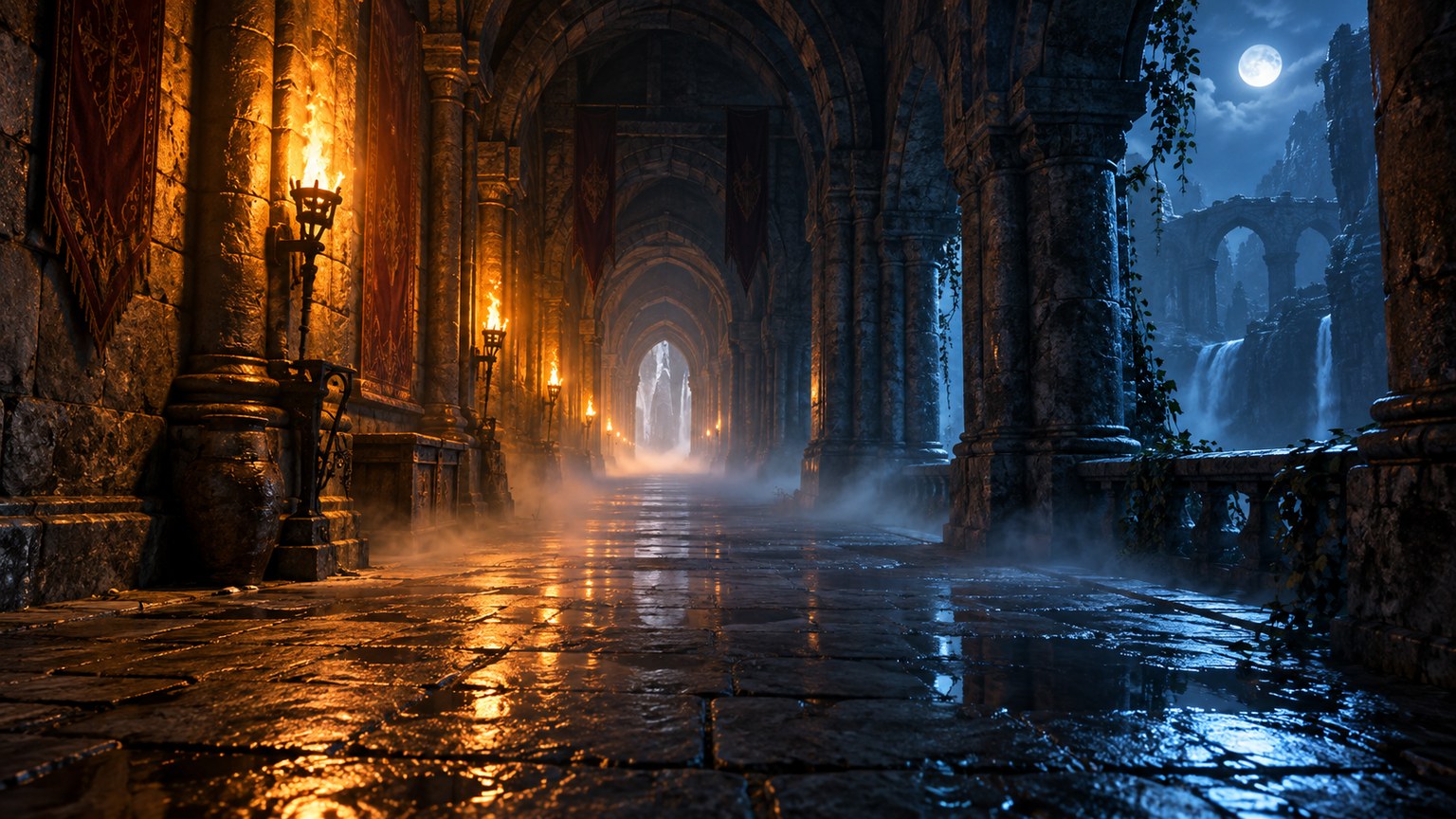
Lighting and Mood in Action/Adventure Games: Creating Atmosphere
Lighting and mood shape action/adventure games by telling players how a place feels before they fully understand it. Color, shadow, contrast, weather, time of day, particle effects, and visibility can turn a simple room into a warning or a promise.
Walk into the same stone hall twice. On the first visit, afternoon sunlight reaches the floor, dust hangs above the benches, and an open doorway frames the courtyard. On the second, a single lamp illuminates a broken chair while the far wall disappears into shadow. The architecture has barely changed, yet you probably move differently. One room invites a glance around; the other makes you wonder what your glance cannot reach.
That imagined comparison captures lighting’s special role in action/adventure games. It shapes the information available to a moving player while establishing an emotional expectation. A level can feel exposed, intimate, sacred, neglected, or unstable before dialogue explains anything. The strongest atmosphere comes from those impressions supporting the actions the scene asks you to perform.
The first bright shape makes a promise
Players rarely inspect every object with equal attention. A bright opening against a darker wall often catches the eye before a sign or a small decorative detail does. Lighting therefore helps establish a visual hierarchy: the place worth approaching, the object worth inspecting, and the background that can wait.
Imagine a ruined tower with three exits. A shaft of daylight reaches one staircase, a brazier flickers beside another, and the third remains in deep shade. The scene has already suggested different possibilities. Daylight might imply an outdoor route; fire might imply recent occupation. Darkness might suggest an unexplored recess. Those are expectations rather than reliable rules, and a game can deliberately complicate them.
The promise matters because exploration depends on interpreting clues. If every decorative candle receives the same emphasis as the essential switch, the player must test everything indiscriminately. If only required objects glow conspicuously, discovery can become a procession of highlighted instructions. Interesting spaces usually leave some room for interpretation while keeping necessary actions legible.
Watch where your eye lands after a camera turn. Does a window establish your next destination? Does a reflection draw you toward a side passage? Notice also when the game lets architecture, movement, or sound carry the guidance. Lighting is more persuasive when it participates in a scene instead of announcing every objective by itself.
Daylight can expose you, and darkness can shelter you
Atmosphere is often discussed as though dimness automatically creates suspense. In practice, the relationship between visibility and vulnerability is more useful. A sunlit courtyard may feel dangerous because there is nowhere to hide. A shaded alcove may feel comforting because it interrupts an enemy’s sightline or provides a quiet place to assess the route.
For stealth, separate what you can see from what the game’s detection system measures. A dark-looking corner is not necessarily concealment. Some games model light exposure; others depend primarily on distance, cover, posture, or scripted rules. A convincing shadow can create a strong visual impression without changing whether a guard notices you.
This distinction helps prevent frustrating assumptions. Test the actual detection feedback in a low-risk encounter, and pay attention to the tutorial’s explanation. If a visibility indicator contradicts the apparent darkness, use the indicator to understand the rules. The image communicates mood; the underlying system determines consequences.
Bright environments can also create unease through emptiness. Picture a deserted station at noon with hard light falling across orderly rows of seats. Nothing needs to leap from a black doorway for the place to feel wrong. The absence of expected activity, combined with unforgiving visibility, can make a peaceful setting uncomfortable.
Color means more after the world teaches you its language
Warm and cool palettes provide useful contrasts, but they do not have fixed emotional definitions. An amber room can suggest hospitality, a furnace, or a dangerous blaze. Blue illumination can resemble moonlight, a tranquil pool, or clinical machinery. The source, location, surrounding materials, and events give the color its meaning.
A game can develop its own associations through repetition. Suppose friendly shelters consistently use steady lanterns, while abandoned machinery emits an intermittent green glow. After several encounters, those treatments become familiar signals. An apparently welcoming lantern in an unexpected place can then generate doubt because it challenges something you learned.
Ghost of Tsushima offers a useful example of deliberate environmental identity. Sucker Punch’s environment art lead described a process that limited foliage variety and emphasized strong color choices to distinguish areas. The effect is relevant to lighting because a scene’s palette and its illumination work together: recognizable masses of color make changes in weather and exposure easier to read.
For players, this is a reason to notice transitions rather than judge individual colors in isolation. Moving from a pale grassland into dense woodland changes the distribution of visible surfaces and shade. Even without an immediate threat, the shift can alter how open the journey feels. Distinct regions give the adventure an emotional geography.
Fog puts distance between knowing and guessing
Mist, smoke, dust, and rain can reveal light while concealing the world behind it. A beam through a clear room may barely register; the same beam through dust becomes a visible shape. That shape can suggest a ceiling opening, divide a corridor, or frame a figure whose surroundings remain uncertain.
Fog is especially effective at changing the confidence of a distant view. A tower may be visible as a silhouette without revealing whether its entrance is accessible. A moving shape can suggest danger before its identity becomes clear. The player receives enough information to anticipate something, while the approach supplies the missing details.
Remedy’s account of Alan Wake 2’s Northlight technology explains that the team improved how fog, transparent surfaces, and lighting fit together. It also describes color grading authored to support the game’s aesthetics in both HDR and SDR. Alan Wake 2 is a survival-horror neighbor to action/adventure, but these production choices illustrate how atmosphere depends on coordinated visual decisions.
For an adventure player, the practical issue is whether obscurity supports a meaningful action. Uncertainty can make an approach compelling. It becomes aggravating when a mandatory climb, small collectible, or enemy attack disappears behind effects that provide no usable cue. A beautiful veil still needs to leave the right pieces of information available.
Light changes the pace of looking
A scene with broad, stable illumination allows you to scan quickly. A scene divided into isolated pools of light encourages a more deliberate search. You look at the visible patch, infer what lies between patches, and reconsider when movement enters the edge of the image. Lighting can therefore influence the rhythm of exploration without changing walking speed.
Consider a hypothetical archive puzzle. If the whole room is evenly illuminated, identifying a missing book becomes a comparison task. If a desk lamp exposes only a few shelves at a time, the same task becomes a sequence of local inspections. Neither treatment is inherently better; each creates a different relationship between the player and the room.
Changes over time are equally important. A passing cloud can soften a landscape and then release it into brightness again. A lamp that stops flickering can make a cramped area feel settled. Returning to a familiar location under altered illumination may suggest that events have changed its character, even when the route remains recognizable.
Contrast also gives quieter scenes their value. If every chamber uses dramatic shafts, aggressive color, and heavy haze, the spectacle can become ordinary. An unadorned kitchen or clear morning path can provide relief and make the next visually intense encounter feel distinctive. Atmosphere benefits from variation in how much a scene asks you to absorb.
Combat needs silhouettes before spectacle
During a fight, mood shares the screen with urgent decisions. You need to recognize an incoming swing, locate an escape route, and distinguish the opponent from the background. A strong still image can fail this test when effects, camera movement, and several overlapping characters enter the frame.
Think about a duel in front of a burning building. Orange light may create a powerful composition, but an orange attack effect against the same backdrop could be difficult to follow. A readable silhouette, contrasting edge, animation cue, or additional sound can help preserve the encounter’s logic. The important information should survive the scene’s busiest moment.
Moving light introduces another challenge. A handheld source may reveal an object only while the camera faces a particular direction. That can support tense searching, but it can also compete with aiming and movement. The game needs to account for the attention divided between illumination, navigation, and the immediate threat.
Camera distance changes this balance. A close view can emphasize a face or a narrow beam while hiding peripheral movement. A wider view can clarify the encounter but reduce the apparent size of a small visual cue. The same lighting arrangement therefore needs to be considered alongside the camera the player actually controls.
When judging a visually elaborate battle, ask whether you understood the failure. Did you miss an attack you could identify, or did the attack disappear into the effects? Repeated confusion may indicate a visibility problem rather than a need for faster reactions. Adjusting available effect or accessibility settings can make the distinction clearer.
A screen adjustment can preserve the intended scene
Lighting reaches you through a display and a room. Daytime glare can obscure a shaded passage that reads clearly at night. An unsuitable display mode can flatten bright areas or swallow dark details. Before deciding a game is impossibly murky, consider whether the viewing conditions are hiding information the scene expects you to have.
Use the game’s own calibration instructions when available, with the display in the mode you intend to play. Avoid copying another player’s brightness number without context: their screen and room may differ substantially. The useful result is a dark scene that retains necessary detail, rather than a particular slider position.
If HDR is supported, its availability alone does not establish that it will look better on your setup. Compare supported modes using actual gameplay, including both interiors and bright outdoor areas. Look for preserved detail and comfortable readability. An option that sounds more advanced is still an option to evaluate, not an obligation.
Keep accessibility adjustments in the comparison. Color indicators, enemy highlighting, subtitles, and contrast options can supply information that a palette alone does not communicate reliably. Their usefulness does not disappear because a scene is artistically ambitious. You should be able to appreciate an atmosphere while understanding the actions needed to progress.
Read a room twice before calling it atmospheric
To examine lighting more closely, choose one quiet space and observe it from two positions. First, stand near the entrance and identify the most noticeable shape. Then move toward it and turn around. The second view may reveal why a doorway looked inviting, why a corner remained uncertain, or how a bright background framed a character.
Follow that observation into play. Did the initial impression lead to a useful discovery? Did the apparent refuge actually provide safety? Did the room’s mood change once its purpose became clear? These questions connect the image to your decisions and help distinguish attractive decoration from lighting that actively shapes the adventure.
A photo mode, when present, offers a useful pause for this exercise. Examine the existing illumination before adding filters or changing the exposure. A polished photograph can demonstrate your editing choices, while an untouched view helps reveal the scene’s original priorities. Returning to normal movement then shows which details remain noticeable during play.
There is also room for deliberate contradiction. A welcoming room can contain a difficult revelation; an intimidating passage can lead to companionship. Lighting establishes an expectation that the story may fulfill or challenge. What matters is whether the contrast feels purposeful within the scene, rather than whether every warm lamp guarantees comfort.
The most memorable illumination gives you something to feel and something to interpret at the same time. A small patch of visibility can become a destination, a warning, or a reason to pause. When those meanings fit the world and remain readable in motion, atmosphere becomes part of how you travel through the game.


