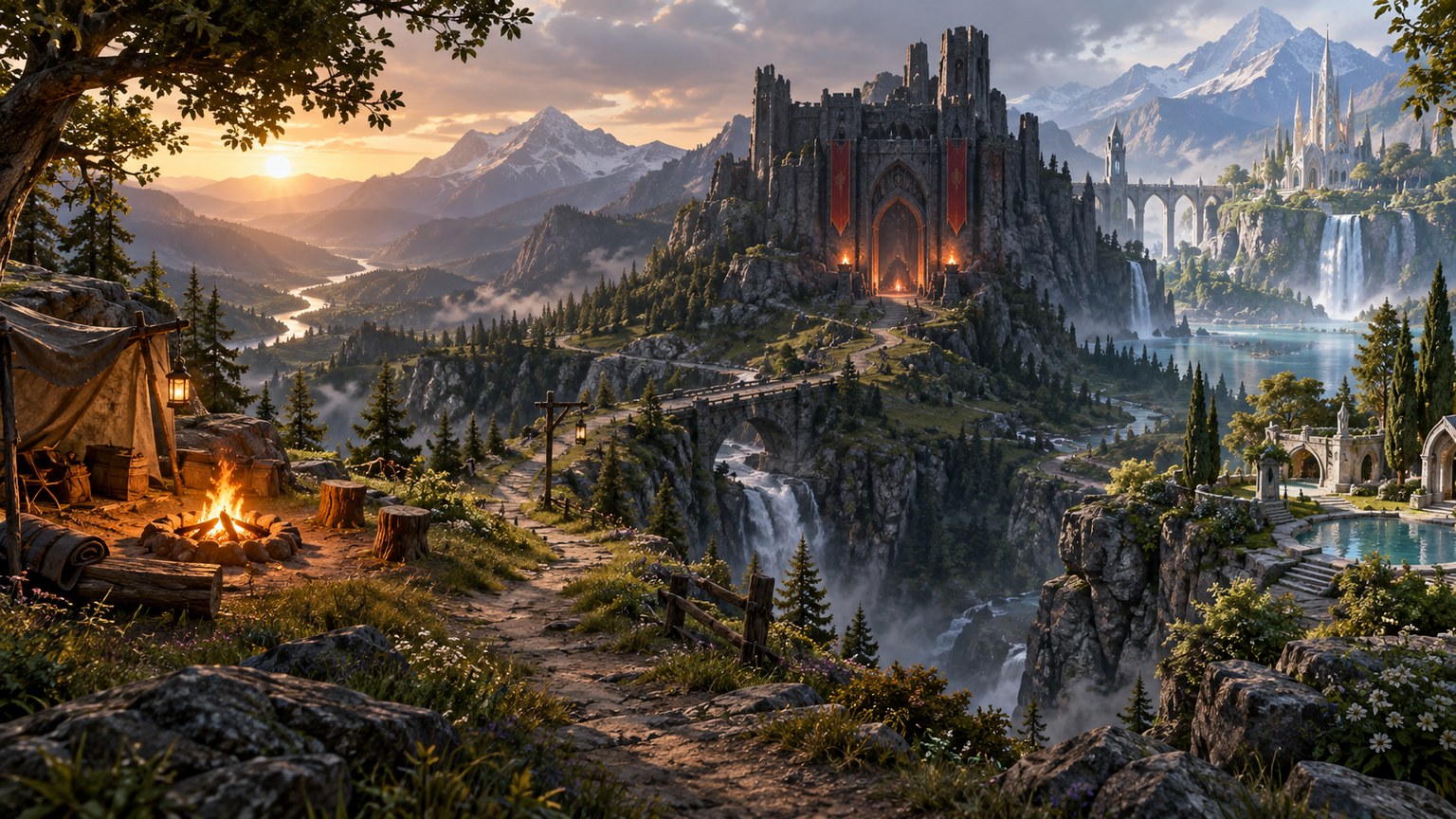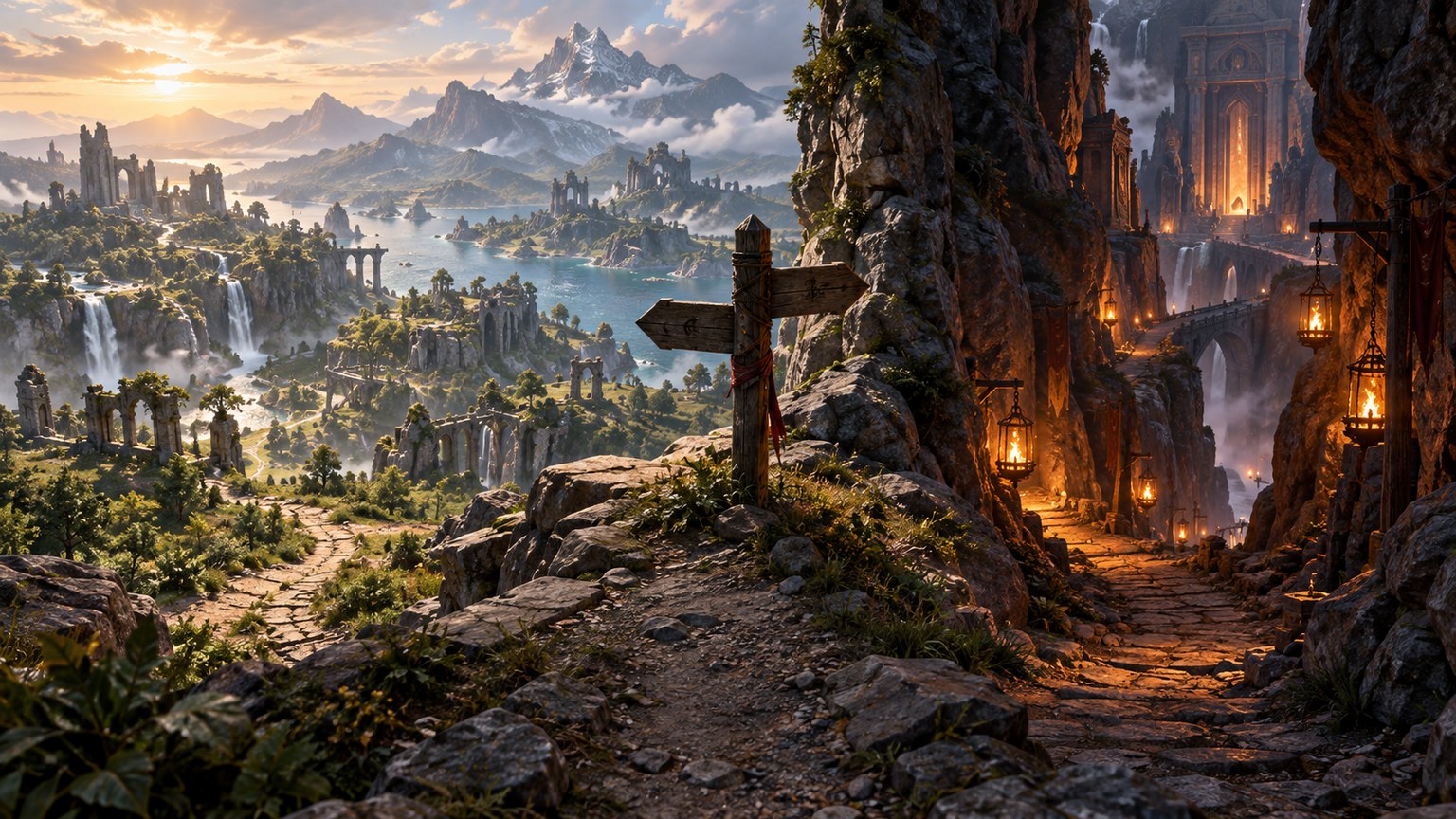
Exploration vs. Narrative: Finding the Right Balance in Action/Adventure Games
Exploration and narrative can pull action/adventure games in different directions. Exploration asks players to wander, test, and discover at their own pace, while narrative often needs timing, focus, emotional build, and controlled reveals.
A: It can provide local route choices, optional spaces, and alternative encounter approaches inside a directed journey.
A: Spatial choice and narrative branching are separate; inspect what the particular game actually lets you affect.
A: It gives you a recognizable place from which to take a contained excursion and return.
A: Select activities that sustain your interest; a full map is not a schedule you must complete.
A: Follow one side thread at a time and reconnect with the main objective afterward.
A: Check the objective and rules for an actual timer or consequence before making that assumption.
A: A new connection, memorable conversation, distinctive encounter, or satisfying view can justify the visit.
A: It can supply the explanation that your own investigation was meant to uncover.
A: A directed objective or contained hub excursion can provide a clear stopping point; investigative play benefits from keeping notes.
A: Recover the last question, destination, or character concern you were following before choosing another direction.
Imagine a game telling you that someone needs rescue immediately, then inviting you to spend the afternoon investigating distant caves. You can enjoy both activities and still feel that they belong to different stories. The problem is not the existence of exploration. It is that the freedom offered by the world and the urgency expressed by the plot pull your attention in opposite directions.
Action/adventure games resolve that tension in different ways. Uncharted 4 keeps a directed campaign while opening room inside individual locations. God of War builds optional journeys around a central relationship. Breath of the Wild lets landscape exploration uncover pieces of an earlier story. Outer Wilds makes investigation the means of understanding its mystery. Looking at those approaches reveals a more useful choice than deciding that either freedom or narrative must win.
Route freedom and story freedom are different decisions
A game can let you choose how to cross a valley while requiring the same conversation at its far end. Another can present a largely fixed corridor but offer a meaningful choice during a confrontation. The first gives control over movement; the second changes a dramatic outcome. Neither kind of agency automatically supplies the other.
Separate three questions when thinking about an adventure: where can you go, when can you go there, and what can your actions change? A map with many paths might still deliver its plot in a fixed order. An optional quest can deepen a character without altering the ending. A mystery can preserve one underlying explanation while letting you discover its clues in several sequences.
These distinctions prevent a disappointing purchase. If you want to shape the story, a large explorable world is not enough. If you want to find your own route, branching dialogue is not enough either. Look for a description of the actual activity rather than treating “open world” as a promise of every kind of freedom.
Uncharted 4 gives wandering a boundary
Uncharted 4’s Madagascar section shows how local exploration can fit a directed adventure. Nate, Sam, and Sully travel in a 4×4, investigate ruins, and search for treasure while pursuing a destination. PlayStation’s hands-on report describes the approach as “wide linear”: more room to navigate inside an authored progression.
The boundary does useful work. You can interrupt travel to inspect something without needing to decide the entire campaign’s direction. That suits a player who enjoys looking around but still wants the next major event to arrive with a clear sense of sequence. The detour belongs to a leg of the journey rather than an unrelated project stretching indefinitely away from it.
Companion conversation also makes the time between major scenes part of characterization. Listening while traveling or stopping can give a location more personality than its collectible count suggests. The important comparison is between a space that merely delays the next scene and one that offers another way to spend time with the people in that scene.
A directed game is therefore not necessarily a game without exploration. Its freedom may operate at the scale of an encounter, a ruin, or an approach to an obstacle. That can be enough when your main interest is the adventure’s unfolding relationships. It will feel restrictive if what you wanted was to abandon the route and define an entirely different expedition.
The Lake of Nine lets a central journey branch and return
God of War’s 2018 design takes a different approach. Its exploration includes optional quests around the Lake of Nine, stories from wayward spirits, and journeys connected to Brok and Sindri. Santa Monica Studio describes how quests encouraged visits to islands and beaches as the lake changed in its developer account of exploration design.
A returning area can provide a familiar point from which to choose a detour. You are not continually replacing the main journey with a separate campaign. Instead, you alternate between continuing and examining another part of a place you recognize. That rhythm can suit someone who likes purposeful side activity but does not want every session to begin with an empty map and no direction.
The quality of the detour matters more than its existence. A side journey can add a local story, a distinct encounter, or something that changes your view of the surrounding world. When it does, returning to the central path feels like bringing back an experience. When it supplies only another errand, the return can feel like resuming after an interruption.
For players, the practical approach is to follow one optional thread at a time. A cluster of unfinished tasks can make even a coherent hub feel scattered. Finish a detour that interests you, then reassess whether to continue the main journey. Optional content does not become more meaningful merely because you clear it all before advancing.
Breath of the Wild places a story inside the landscape
Breath of the Wild begins with Link waking without his memories, a premise Nintendo establishes on its official game page. The relationship between the hero and the world is therefore partly a question of recovering what happened. Exploration is well suited to that question because a place can become the route to a recollection.
Nintendo’s Explorer’s Guide explains that stored photographs point toward scattered memory locations, with tools and help available for identifying them. A landscape is not simply ground between story scenes: comparing a picture with the terrain can itself become a reason to travel.
This approach separates discovering a story fragment from following a prescribed sequence of scenes. Players may form impressions from different early discoveries and revise them later. The authored events remain authored, but the route into understanding them has more variation. That distinction explains why someone can value its freedom yet prefer a more tightly arranged dramatic presentation.
Try treating a memory search as an observation task rather than immediately opening a solution. Look for a distinctive landscape relationship or landmark in the image, then consider where that view could exist. The satisfaction lies partly in recognition. If uncertainty becomes exhausting, a targeted hint can restore momentum without deciding every future destination for you.
Outer Wilds makes the investigation carry the narrative
Outer Wilds is a particularly revealing example because it does not treat story mainly as a reward handed out after exploration. Mobius Digital describes a solar-system mystery in an endless time loop, with environments changing over time and tools for examining hazards, signals, and ancient writing. The developer’s overview establishes those foundations without requiring an ending spoiler.
Exploring answers a question and often creates another. A place can matter because it helps connect an earlier observation to something you did not understand. Your choice of destination participates in constructing the explanation. Movement, attention, and interpretation serve the same activity rather than competing for separate portions of an evening.
That is powerful for someone who enjoys uncertainty, but uncertainty is a real demand. A player who prefers a clear sequence of objectives may experience a loose investigative lead as a lack of direction. The same openness that produces discovery for one person can produce aimless travel for another. Neither response is evidence that the player has misunderstood what enjoyment should be.
For a manageable session, choose one unanswered question before departing. Revisit the relevant evidence afterward and ask what changed. A useful discovery might be a connection rather than an item. Avoid detailed solutions when curiosity is still carrying you; knowing a mystery’s answer can remove a form of exploration that a new save cannot restore.
Urgency works better when the detour belongs to the situation
Return to the rescue example. A detour to obtain a necessary tool can support the mission, while an unrelated collecting marathon may weaken its emotional urgency. The difference is the reason the character has for leaving the direct route. Time spent away can still feel purposeful when the action is connected to the problem.
There is also a difference between dramatic urgency and an actual timer. A worried companion does not necessarily mean the game will punish delay. Check the objective and the game’s rules rather than guessing from dialogue alone. Players can make informed choices only when they understand whether a delay changes the outcome or merely changes the pace of experiencing it.
A quieter narrative setup can make leisurely exploration easier to accept. Investigation, preparation, or learning about a region gives the character a reason to look around. In a tightly pressured scene, the same slow wandering may feel less convincing. Good balance is situational: the right amount of freedom can change from one part of a campaign to the next.
A detour should give you more than distance traveled
Ask what an optional location changes. Does it reveal something about a person, introduce a distinctive challenge, connect two pieces of information, or give you a new way to operate? If it only increases the distance between main missions, its size may be doing more work than its content.
Environmental storytelling deserves the same scrutiny. A ruined room can imply a past event through its arrangement, but atmosphere alone does not establish every conclusion you draw. Separate what the game visibly shows from your interpretation. Discovering a suggestive place can be satisfying even when the explanation remains incomplete.
It is also reasonable for a detour to offer pleasure rather than a crucial revelation. A striking view, a playful traversal problem, or an amusing conversation can justify a stop. The question is whether you enjoyed that stop on its own terms. Every side activity does not need to alter the main plot, and every material reward does not prove the activity was worth doing.
Be selective with collectibles if narrative continuity matters to you. Searching every corner during an emotionally charged sequence can change its rhythm. You may prefer to move with the scene and investigate optional spaces when the adventure opens room for it. Where revisiting is possible, that can preserve both interests; where it is not, choose the experience you value more.
Adjust the balance to the way you actually play
For short sessions, a directed destination may be helpful: you can make visible progress without spending the evening choosing a direction. A returning hub offers another option, letting you take one contained excursion. A broad mystery can also work in short sessions, but it asks you to remember the question and the evidence between visits.
After a break, read the journal or revisit the last relevant clue before launching another expedition. Reconstruct the thread you were following. If you instead pick up every available task at once, the resulting confusion may come from switching contexts rather than from the game lacking a story.
You can change your approach halfway through a campaign. Someone who initially enjoyed clearing a map may later want to follow the central plot; someone rushing toward an ending may decide to spend time with a side character. Optional freedom is useful precisely because your interest can vary. Completion percentages need not determine the rhythm of every play session.
Choose a connection between wandering and meaning
Think of these examples as different ways to connect action with story. Uncharted 4 offers local wandering inside a directed journey. God of War provides excursions that return to a central path. Breath of the Wild makes landscape recognition part of recovering the past. Outer Wilds lets investigation build an understanding of the mystery itself.
The balance you want is the one that makes your next movement feel worthwhile. Sometimes that means trusting a clear destination. Sometimes it means following a question with no obvious answer. Notice whether a detour makes the adventure more vivid or merely makes you forget why you started it. That observation is a better guide than the size of the map or the number of scenes waiting at its end.