The New Golden Age of Game Collecting
Video game collecting has entered a thrilling new era. What once felt like a hobby built around dusty cartridges, childhood memories, and weekend flea market hunts has become one of the most exciting collector spaces in modern pop culture. In 2026, rare video game collectibles are not just conversation pieces for game rooms. They are serious collectibles with real financial weight, emotional power, and cultural importance. The most desirable items can sell for thousands, tens of thousands, or even far more when condition, scarcity, and nostalgia align. A sealed game from the 1980s, a prototype controller, a rare tournament cartridge, or a limited-edition console can instantly transform a collection from fun to extraordinary. Some pieces are valuable because almost nobody bought them. Others are valuable because everybody remembers them. The magic of rare gaming collectibles comes from the combination of memory and mystery. Collectors are not simply buying plastic, cardboard, and circuit boards. They are chasing the feeling of a launch-day console, the thrill of a favorite childhood franchise, or the prestige of owning something most fans will never see in person.
A battered game box found in storage is not valuable simply because it is old. The title, production version, original components, condition, and evidence that it is genuine all matter. In 2026, documented auctions still show video game items selling for thousands of dollars, but the gap between an ordinary copy and an exceptional one can be enormous. A headline sale is a record for one object on one day, not a price tag for every cartridge with the same cover. The most interesting collectibles are worth studying as pieces of gaming history before anyone tries to assign a number.
The label on the box is only the beginning
Two games with the same title can be very different collectibles. A first production may have a distinct seal, box text, screenshot, rating mark, or manufacturer code. A later print can be common even when the earliest version is scarce. Region and platform matter too: a Japanese release, a North American edition, and a promotional copy might have different packaging and audiences. Before comparing prices, identify the exact version in your hands.
Completeness changes the comparison again. A loose cartridge is not the same object as one with its original box, manual, inserts, and matching accessories. A sealed copy is not automatically pristine; wrap can be torn and cardboard can be crushed. A complete copy can still have replaced components. Collectors often use the abbreviation CIB for complete in box, but a listing should spell out what is actually present. Small details are the difference between a meaningful comparison and a misleading one.
A tournament cartridge that was never a normal release
Nintendo World Championships 1990 cartridges are a classic example of rarity tied to a specific event. They were produced for the competition rather than for ordinary retail shelves. Surviving gray cartridges have appeared at public auction with identifying numbers and condition reports. One graded gray example sold through Heritage Auctions in 2021 for $180,000; another, in a different grade, sold in 2023 for $63,000. Those results show both the level of interest and how much individual characteristics can matter.
A seller claiming to have one needs more than a similar gray shell. The board, label, number, wear pattern, and history of ownership deserve examination by a qualified specialist. A reproduction made for display may be enjoyable, but it belongs in a different category. Tournament provenance is part of the object. Without it, an asking price borrowed from an authenticated sale tells you almost nothing.
Stadium Events and the problem of similar-looking games
The North American NES release of Stadium Events is sought after partly because it was short-lived before a rebranding of the game and its fitness accessory. It is easy to confuse the rare title with the more familiar World Class Track Meet or with copies from another region. Identification requires the correct game, packaging, and platform details, not merely an image of runners on a box.
A complete-in-box Stadium Events copy graded PSA 7.0 sold at Heritage in March 2026 for $45,000. An earlier loose cartridge sold in 2019 for $10,500. Those are separate objects sold in separate markets; neither result is a current quote for a loose cart pulled from a drawer. A manual, box, and credible condition assessment can change what bidders are willing to pay. If you think you have this game, document the cartridge and every accompanying piece before cleaning or separating anything.
Famous sealed games are not interchangeable
Super Mario 64 made global headlines when a sealed, exceptionally graded copy sold for $1.56 million in 2021. The number is memorable, but the lesson for a collector is about specificity. The auction described a particular production, grade, and seal quality. A later auction of a different sealed copy with a lower grade reached a very different result. Millions of people owned and played Super Mario 64; the premium was attached to a rare state of preservation and the bidding for that individual example.
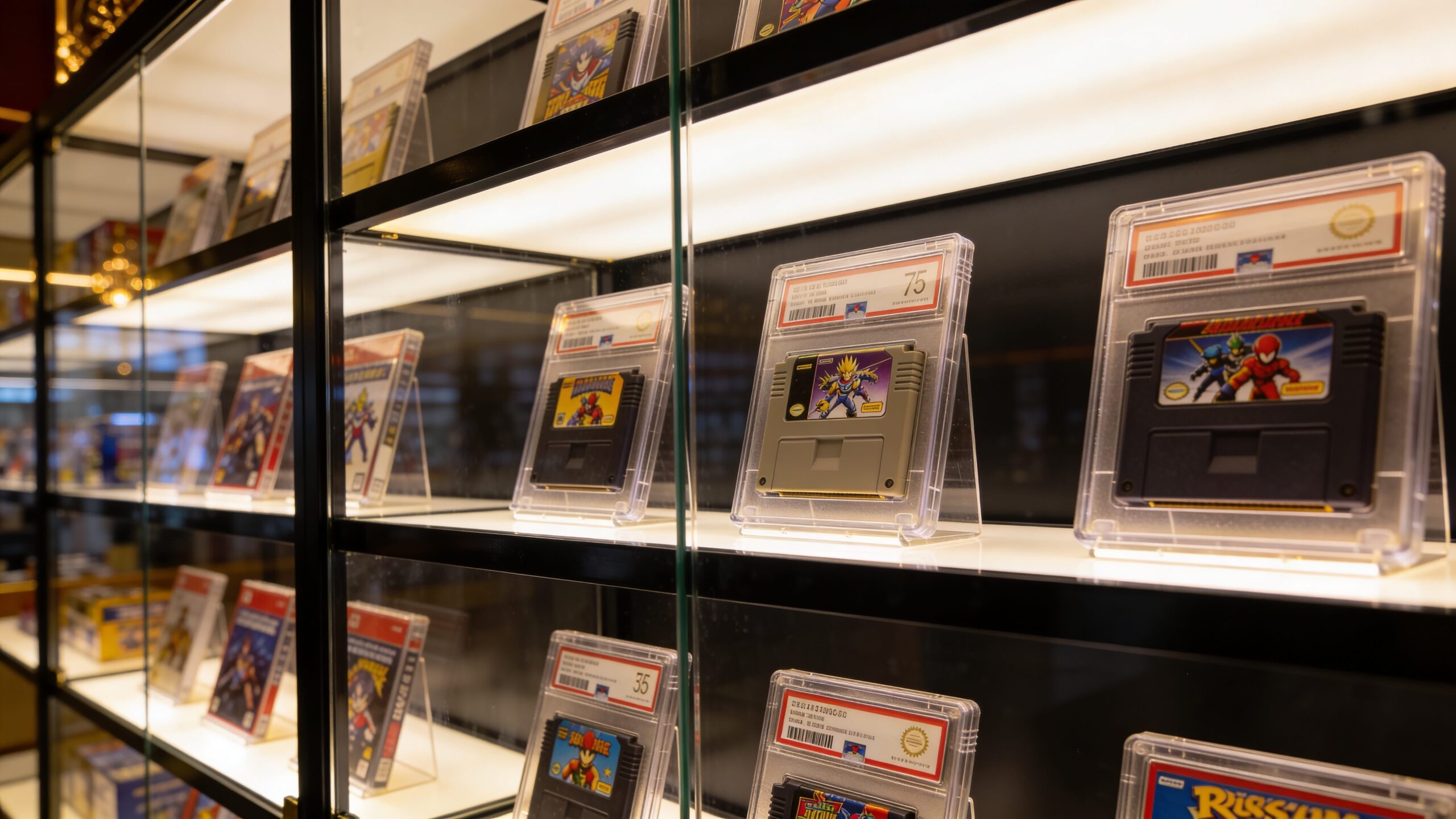
When evaluating sealed games, compare the exact printing and the condition of both box and seal. Watch for tears, crushed corners, fading, and signs of resealing. A protective case can preserve an item, but it does not repair damage beneath it. Historical record sales also came during a particular period of collector enthusiasm. In 2026, a recent comparable sale is more useful than the highest number ever reported for the title.
Pokémon print details can move the comparison
Original Pokémon Game Boy games have an enormous audience, yet that popularity alone does not make every copy a five-figure collectible. The box variant, production text, screenshot, seal, grade, and completeness all influence a sale. Heritage recorded a sealed Pokémon Blue Version fourth-production copy graded PSA 9.8 A++ selling for $32,500 in August 2026. Another sealed Blue copy from a different production and grading profile sold for $10,625 in March. The differences are not visible from the title on a shelf.
For an opened game, the battery, label, box, manual, and any original inserts should be checked and described separately. Counterfeit cartridges and reproduction boxes create a real identification problem in a popular franchise. A seller may honestly remember buying a game decades ago and still have a replaced box or later insert. Treat the provenance and the physical details as evidence to reconcile, not as a story to accept without inspection.
Cult games with unusual packaging
Some valuable collectibles were not tournament artifacts or mass-market icons. EarthBound for the Super Nintendo, for example, is known for its oversized North American package and included player’s guide. That makes completeness particularly important: a cartridge alone tells a different collecting story from a set with the guide and box. A qualified, complete and unused example sold at Heritage in June 2026 for $4,000. Its condition and the auction’s precise description are essential context for that figure.
Other niche RPGs and survival horror releases can attract buyers when a specific version is hard to find in good condition. Resident Evil Gaiden for Game Boy Color offers a smaller-scale illustration: a sealed, highly graded copy sold for $1,625 in June 2026. That result is not evidence that every opened copy has the same value. It shows why collectors search beyond the titles that generate spectacular headlines and why a precise sold record matters more than a confident listing price.
Prototypes are evidence of a path games did not take
A development cartridge or prototype console can be valuable because it documents work that never reached ordinary consumers. The Nintendo Play Station Super NES CD-ROM prototype sold at Heritage in 2020 for $360,000. Its significance came from the Nintendo and Sony collaboration it embodied, its unusual survival, and the extensive attention given to its history. That is a very different market from ordinary boxed console hardware.
Prototypes require especially careful authentication. A development label, a unique shell, or an unreleased program is intriguing, but none proves origin by itself. Chain of custody, technical inspection, contemporary records, and the ability to distinguish a period object from a modern modification all matter. Sellers should avoid powering on fragile hardware merely to make a video. Preserve the current state and seek knowledgeable assessment before experimenting with something that may be historically important.
Promotional objects need their own comparisons
Retail kiosks, store displays, convention material, and competition prizes were often discarded after their short working lives. A surviving piece can be striking because it carries the look and context of a particular launch. Yet “promotional” does not guarantee scarcity or demand. A mass-produced poster and a documented store display from a limited campaign should not be priced from the same search results.
Examine construction, logos, dates, and signs of use. Was the display intended for a chain of thousands of stores, or for a single event? Is it complete with original panels, lights, or hardware? Does the seller have photographs showing it in use? Fragile size can also affect the market: shipping a kiosk safely costs more than shipping a cartridge. A local buyer may value it highly while distant bidders hesitate. The best comparison matches both the kind of object and its practical condition.
How to read a sold price honestly
Start with completed sales, not unsold asking prices. Record the date, venue, exact variant, condition, contents, and whether the displayed total includes a buyer’s premium. Auction houses commonly show an all-in realized price, while a private listing may show only the seller’s ask. One sale can also be an outlier if two determined bidders wanted the same rare example. Several recent, comparable transactions make a firmer picture.
Then account for the differences that a short headline omits. Was one copy sealed and the other opened? Did one include a verified manual and the other a replacement? Did the grading company note a qualified grade or restoration? Is the sale from 2021 or 2026? Market taste and available inventory change. An honest estimate may be a range with wide uncertainty, especially for a prototype or prize with few transactions. It should never turn a historical record into a promise of future proceeds.
Authentication before grading
Third-party grading can make a description more consistent and provide a holder that protects an item, but it is not a substitute for understanding what was submitted. Verify the exact version and completeness first. Consult a specialist if the item might be a prototype, a rare variant, or a counterfeit. Keep purchase receipts, photographs, correspondence, and any history from the original owner. Good provenance can make a rare object easier to evaluate.
Grading also has costs, turnaround time, and risks in transit. A common game may not gain enough value to justify the fee. A rare item may warrant insurance and careful packaging before it leaves your possession. If you are considering a sale, ask how the prospective venue handles authentication disputes and returns. The highest potential price is only one part of the decision; confidence in the item and the transaction matters too.
Preserve the evidence while you decide
Photograph all sides of a box or cartridge in even light, including serial numbers and any damage. Keep inserts together, but do not force a tight package open to improve a photograph. Avoid household cleaners, replacement labels, and improvised repairs. What looks like an improvement can remove evidence of original manufacturing or reduce collector interest. Store paper and cardboard away from sunlight, moisture, and extreme temperature changes.
For electronic items, leaking batteries and aging capacitors require thoughtful handling. Do not assume a nonworking collectible is worthless, and do not attempt a repair that erases original parts without documenting it. A specialist can advise on safe storage and reversible work. Preservation is useful even if you never sell: the object remains legible as a piece of game history rather than becoming a polished but ambiguous display piece.
What “worth thousands” means in 2026
The phrase describes documented outcomes for particular collectibles, not a guaranteed minimum for a title or franchise. Tournament cartridges, a complete Stadium Events, exceptional sealed games, and historically important prototypes have all produced substantial auction results. Other objects carrying the same names may differ so much in condition or authenticity that the comparison fails. The most responsible first step is identification, followed by recent sold records for truly comparable pieces.
A rare collectible has two kinds of value: the market’s willingness to pay and the history the object preserves. Knowing its exact variant, contents, and provenance helps with both. If a surprising item appears in a collection, resist the urge to price it from the largest headline. Document it carefully, learn what it is, and let the evidence lead the conversation.