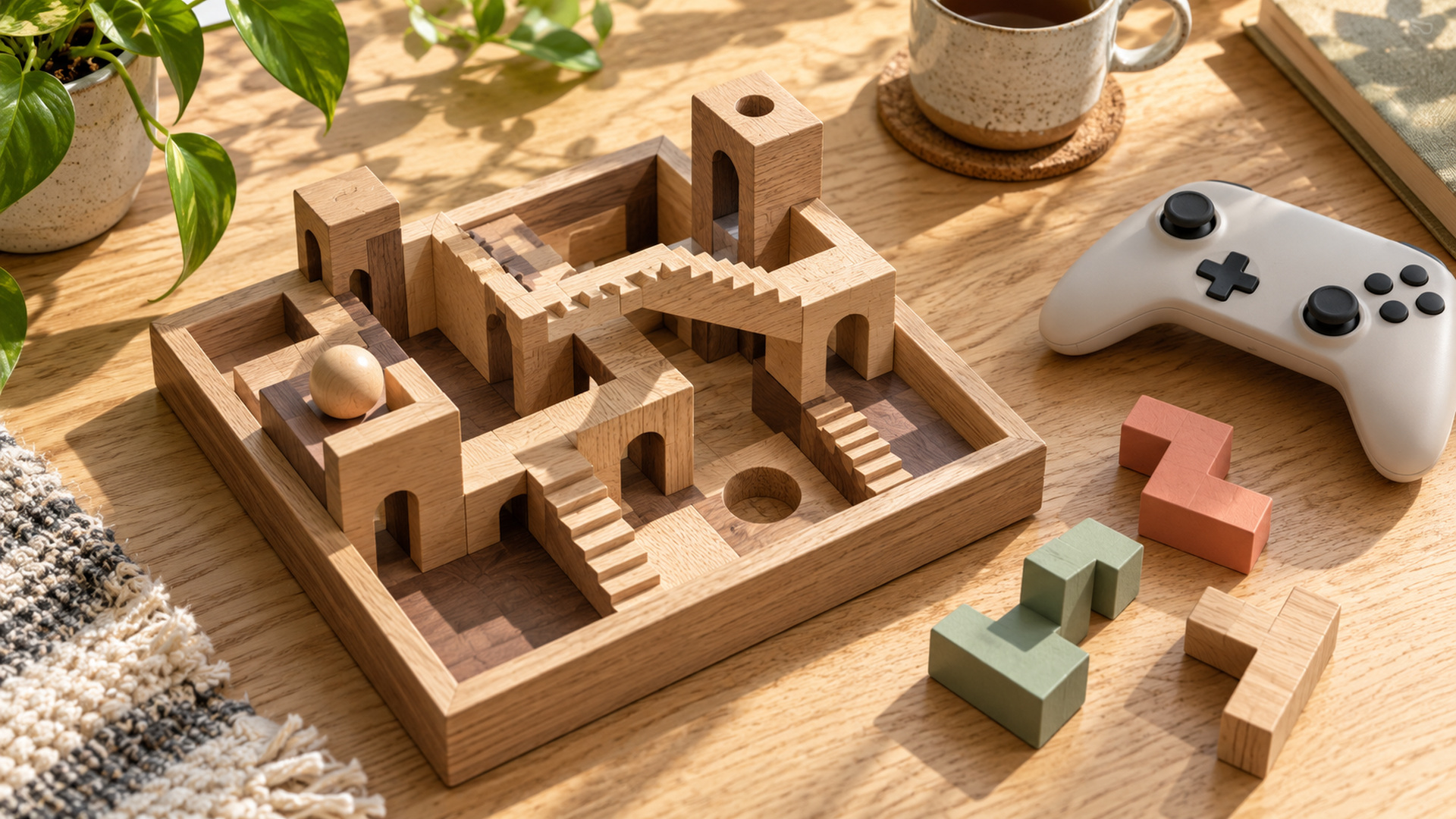
Begin with a puzzle that makes experimentation feel inviting
The best first puzzle game gives you something understandable to try before asking you to understand everything. Monument Valley lets you manipulate an architectural illusion; A Little to the Left starts from familiar household objects; Dorfromantik turns a landscape into a sequence of tile decisions. Portal 2 adds first-person movement and a more directed adventure, while A Monster’s Expedition offers a deeper spatial challenge with a gentle presentation. These five recommendations cover different kinds of beginner, including someone new to game controls and someone comfortable with games who wants an introduction to logical discovery. The choices below explain what you actually do, what supports learning, and where difficulty remains. None requires treating a complete solution guide as your instruction manual.
A: Monument Valley and the object-arranging or tile-placement options avoid Portal 2’s first-person camera demands.
A: Yes; recognizing the objects does not always reveal which organizing principle the puzzle expects.
A: Successive placements build an evolving board whose choices carry forward into later decisions.
A: It provides a route for exploring placement without the standard run’s tile-supply pressure.
A: A player interested in a directed spatial adventure, particularly one already comfortable moving in first person.
A: Its log interactions develop into substantial spatial reasoning despite the modest controls and friendly presentation.
A: It lets you investigate a consequence without treating every mistaken push as a complete restart.
A: The cooperative experience is separate from the single-player campaign and should be selected accordingly.
A: Decide whether you want frequent task closure or the continuing pleasure of developing an arrangement.
A: It should explain the actual actions, learning supports, remaining difficulties, and the kind of curiosity the game rewards.
Monument Valley: the most approachable architectural introduction
Monument Valley is the first recommendation for someone who wants a puzzle to feel like a small, intriguing object. You guide a character through structures whose apparent connections can change when parts of the architecture move. The central pleasure is noticing that a view which seemed impossible can become a usable path. You are examining the picture as well as the route. That makes the introduction different from a game that first asks you to learn a large collection of symbols or remember several abstract rules.
The controls help keep that attention on the environment. Selecting a destination and manipulating a visible architectural feature is a different physical demand from steering a first-person character through a timed jump. A newcomer can spend more effort asking where a path might connect. The compact presentation also helps a puzzle remain readable: a tower, staircase, or movable section can become the immediate subject of investigation. The game’s visual elegance is functional because it draws attention toward those relationships.
The limitation is that this is a guided series of discoveries rather than an expansive logic curriculum. Someone who wants a dense system to study for dozens of hours may prefer another selection. Start with the original game if you want the clearest introduction to its particular idea, then use ustwo’s series site to distinguish releases and their supported platforms. The reason to recommend it is its low-friction invitation to look again. A satisfying early insight often comes from reconsidering what the image permits, rather than executing an action more quickly.
A Little to the Left: familiar objects, unfamiliar organizing rules
A Little to the Left is the pick for someone who enjoys noticing size, symmetry, color, and the relationships between everyday things. Its official store description presents household sorting and arranging, multiple solutions in some puzzles, a hint system, and an option to move past a puzzle. You manipulate recognizable objects, so the initial question can be as approachable as how these items might belong together. The challenge comes from identifying the arrangement the particular puzzle recognizes, which is not always identical to your own preferred tidying rule.
That distinction makes the built-in support important. A hint can help bridge the gap between a plausible interpretation and the intended one, while moving onward prevents one ambiguous arrangement from blocking the whole evening. It is a good beginner recommendation when short, self-contained tasks appeal and physical execution should remain modest. It may be less satisfying if you strongly prefer a rule system whose consequences are completely explicit from the beginning. Approach it as playful pattern interpretation. A solution can feel elegant when it clicks, but uncertainty about the intended organizing principle is a real part of the experience.
Dorfromantik: learn through placement rather than a single answer
Dorfromantik suits a beginner who would rather make a series of reasonable decisions than hunt for one hidden solution. You place hexagonal landscape tiles, extending features such as forests, fields, villages, and waterways. Matching edges and completing quests influence how the landscape develops and how a normal run continues. The board is therefore both the result of earlier choices and the setting for the next one. Its calm appearance does not remove the strategic decisions; it makes them easier to examine without the pressure of an action scene.
The key beginner distinction is between making a pleasing place and maximizing a score. Those aims can overlap, but chasing every opportunity immediately can make the introduction busier than necessary. Toukana’s official description also identifies a Creative mode, which provides a different route for someone who wants to explore placement without the standard run’s tile-supply pressure. That is a meaningful support feature: it changes the task rather than merely telling a struggling player to concentrate harder.
Choose it if you like seeing consequences accumulate across a growing board. A placement that looks attractive now can leave an awkward edge to resolve later, so the learning is about anticipation rather than reflex. It is not the best first pick for someone who wants a clearly authored chain of revelations or a character-led story. Its open-ended quality can also make stopping less obvious than finishing a compact chamber. The recommendation is strongest for a patient planner who finds the act of arranging the landscape enjoyable even before the score becomes a serious concern.
Portal 2: a guided adventure for beginners comfortable moving in 3D
Portal 2 is the strongest selection when you want a puzzle game to carry you through a larger comic science-fiction adventure. A portal connects two compatible surfaces, letting you reconsider how to reach a destination or move an object through a room. Later devices build on that spatial vocabulary. The important pleasure is changing your understanding of the chamber: an apparently unreachable ledge becomes accessible when a route is understood differently. The Valve store page distinguishes the single-player campaign from the separate cooperative experience, so buying it for a friend session should involve choosing the appropriate activity.
The beginner qualification concerns controls. Looking around, aiming at a surface, walking, and occasionally coordinating movement are extra tasks that do not exist in the same way in Monument Valley or a household sorting puzzle. Someone already comfortable with a first-person camera may find the introduction remarkably welcoming; someone encountering that camera for the first time is learning movement and puzzle reasoning together. That does not make Portal 2 unsuitable, but it changes the recommendation. Select it for a directed adventure and spatial experimentation, and allow time to become comfortable moving before interpreting hesitation as a failure to understand the puzzle.
Portal 2 cooperation changes the problem you are solving
Playing with a friend is a separate recommendation rather than a guarantee that a solo puzzle becomes easier. Each cooperative player controls a pair of portals, so a route can depend on a connection another person maintains. That creates a useful reason to describe what you intend to do before moving or replacing a portal. Someone who enjoys discussing a shared spatial problem may find that relationship welcoming, while someone who prefers quietly testing an idea alone may want the single-player campaign first. The distinction matters for beginners because cooperation adds communication to the reasoning; it does not simply remove the need to understand where the next action will lead.
A Monster’s Expedition: gentle presentation with substantial depth
A Monster’s Expedition is the recommendation for someone who wants to grow into a demanding puzzle system. You push trees to make logs and use them to create routes between islands. The basic actions are small enough to understand quickly, while their consequences become surprisingly rich. A log’s position and orientation can determine whether it helps you cross water or blocks a useful move. The developer’s description emphasizes connected islands and discovery through simple mechanics. The appeal is learning how much those modest actions permit.
Undo is particularly important to the beginner experience because a mistaken push can become information instead of a reason to restart the whole expedition. You can investigate a possibility, see why it fails, and recover the earlier position. The island structure also lets the game present a concentrated spatial problem within a much larger journey. It encourages a different kind of persistence from performing a difficult jump repeatedly. You are revising an arrangement and an explanation, with time to look before making the next move.
This is the most qualified beginner recommendation on the list. The friendly art and small controls should not be read as a promise that the complete game stays easy. Later discoveries can ask for substantial spatial reasoning, and a player who wants constant forward motion may become frustrated. It is best as an early step toward deeper puzzle games for someone who enjoys the process of understanding a compact system. Pick Monument Valley for the lightest architectural entry; pick this when the prospect of returning to a stubborn island with a new idea sounds appealing.
Choose a complete experience rather than a vague promise of relaxation
Imagine choosing between these games for an evening when you want to finish something. Monument Valley’s authored architectural sequence gives progress a different shape from Dorfromantik’s developing landscape. Completing a compact route can feel like closing a small chapter, while extending a tile board can make the next placement tempting even after a satisfying stretch. A Little to the Left sits between those expectations: individual arrangements can provide frequent stopping points without requiring you to reach the end of the whole collection. This is a comparison of the activity, not a universal completion-time estimate. The best choice depends on whether finishing a small task or remaining absorbed in an ongoing arrangement is what makes a session satisfying for you.
Now consider an evening when you want a larger project to return to. Portal 2 gives the return a story and a directed journey, whereas A Monster’s Expedition makes an expanding understanding of its spatial system the central attraction. A person who wants a character’s circumstances to pull them onward may prefer the former. Someone who likes recognizing a new possibility in an apparently familiar arrangement may prefer the latter. Dorfromantik instead supports the pleasure of creating another landscape and reconsidering placement priorities. These distinctions explain why the calmest-looking selection is not automatically the most relaxing one for every reader. Match the structure of progress to your preference, and the beginner recommendation becomes more useful than a promise that you will never get stuck.
Match the first game to the kind of difficulty you want
There are at least three different things a beginner may find difficult here: interpreting a hidden rule, reasoning about space, and operating a character. A Little to the Left emphasizes the first; Monument Valley and A Monster’s Expedition emphasize different levels of spatial discovery; Portal 2 adds the largest movement demand. Dorfromantik asks for planning across an accumulating board instead of solving one fixed arrangement. These distinctions matter more than a generic easy-versus-hard label. A person comfortable with 3D games can struggle with an organizing puzzle, while someone new to controllers may reason brilliantly about an island. Choose the game that makes the unfamiliar part interesting while keeping the other demands manageable.
Use the available help without giving away the pleasure
The right support preserves the part of the puzzle you came to enjoy. Undo in a spatial puzzle keeps experimentation available; a hint in an organizing puzzle can clarify which relationship deserves attention; a noncompetitive mode can remove score pressure while you learn placement. Those are different forms of help. They should be evaluated through what they let you discover rather than treated as interchangeable buttons that make every game equally accessible.
For a first purchase, decide whether you want a compact visual journey, short arranging tasks, a developing landscape, a guided first-person adventure, or a deep island system. That gives each recommendation a clear job. Platform controls, supported languages, and accessibility features still deserve checking on the exact edition’s page, especially when touch, mouse, and controller versions differ. Then let the game introduce its own idea before searching for complete answers. A strong beginner choice is one that gives you enough purchase on the problem to enjoy the next discovery yourself.