
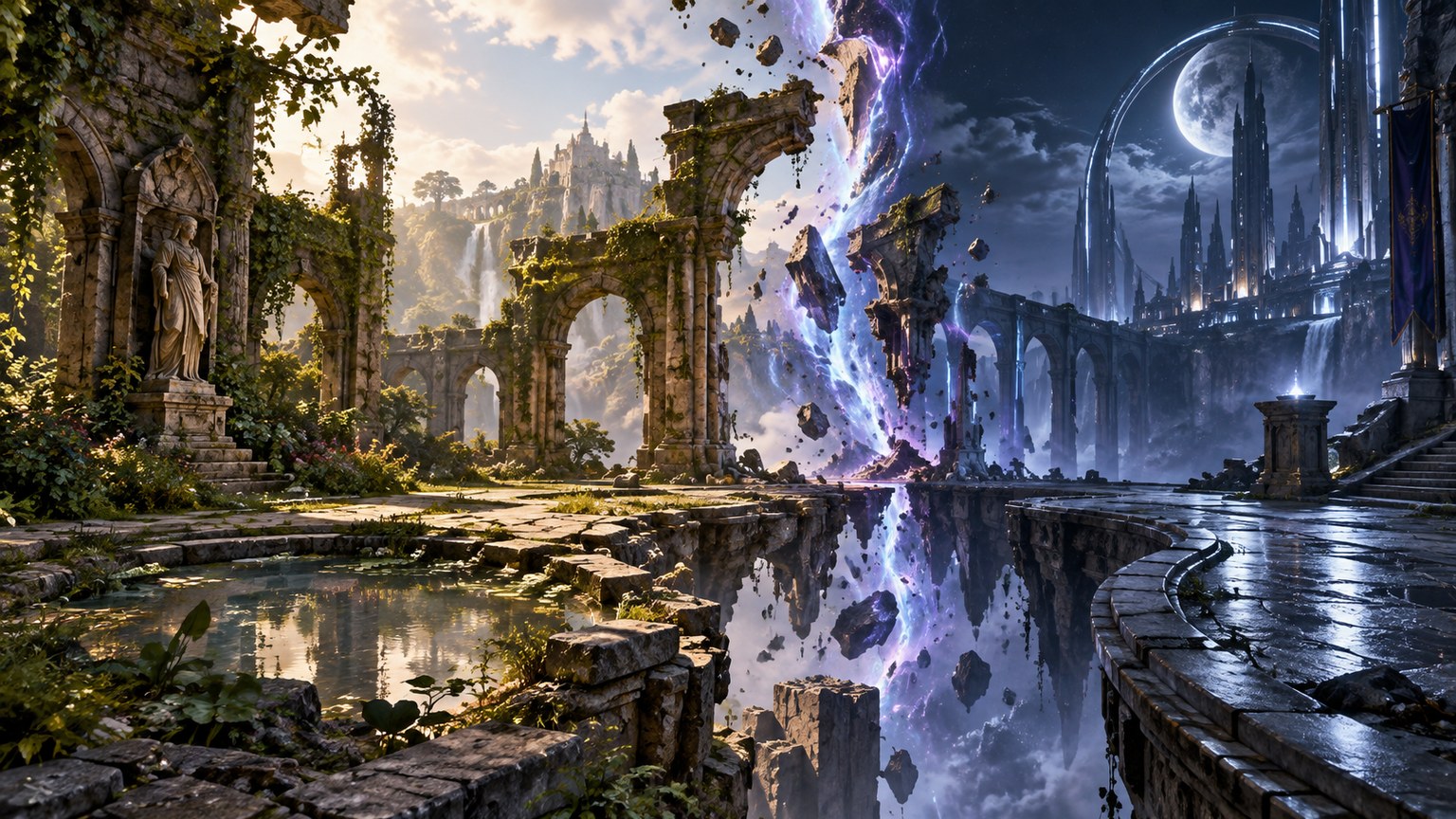
How Time Travel and Alternate Dimensions Add Depth to Action/Adventure Games
Time travel and alternate dimensions add depth to action/adventure games when they reshape exploration, puzzle logic, stakes, memory, routes, characters, and consequences instead of acting as simple visual tricks.
A: No. Reversal, era switching, and repeating worlds offer different actions and limitations.
A: The original game released in 2003; its rewind example is not a claim about a remake’s release or features.
A: Your usual powers do not work there, and the timepiece supports comparison and movement between periods.
A: Its practical role is movement through dimensional connections, not reversing a recent decision.
A: It is an exploration mystery, included because its loop shows how timing can reshape discovery.
A: Keep the observation that changed your understanding, including whether arrival time affected access.
A: Identify the obstruction in one state and compare that exact location in the other.
A: Its larger fiction can stay mysterious while still explaining the consequences of the actions you control.
A: They can redirect observation without replacing the connection you would otherwise discover yourself.
A: Meaningful use changes a route, position, inference, or character relationship you can engage with.
A corridor can become a puzzle when the same space exists in two states. The door that blocks you now may have been open years ago. A safe platform in one reality may be absent in another. A failed jump might be reversible, while a journey through a repeating day might succeed only after you understand when to arrive. Time and dimensional mechanics make familiar actions carry additional questions.
Their depth comes from those questions, not simply from a complicated fictional explanation. Prince of Persia: The Sands of Time, Dishonored 2, Ratchet & Clank: Rift Apart, and the exploration adventure Outer Wilds use very different systems. Comparing them shows how manipulating time or space can change learning, navigation, combat, and storytelling without requiring every game to contain a branching multiverse.
Start by identifying what the power actually changes
A short rewind undoes recent events. Switching between eras places you in another historical state of a location. A repeating loop resets a larger stretch of events, often making knowledge more valuable than physical progress. Traveling through a dimensional rift connects spaces or realities that would otherwise be separate. These systems can look similar in a trailer while asking very different things of the player.
The distinction matters when you get stuck. A rewind may help correct your timing but cannot necessarily open a permanently locked door. An era switch might bypass that door without changing history at all. A loop might require returning at a different moment rather than using a special button beside the obstruction. Understanding the available operation is the first step toward reading the puzzle correctly.
Be especially careful about assuming cause and effect. Some games let an action in the past alter the present; others let you move between established states whose relationship remains fixed. Likewise, a portal is not automatically a time machine. The game’s actual rules should guide your decisions, even when the story uses expansive language about realities and possibilities.
A rewind keeps the mistake close enough to learn from
In the original 2003 Prince of Persia: The Sands of Time, the Dagger of Time can rewind the last few seconds of action. Ubisoft’s retrospective describes this as a way to undo recent traversal or combat mistakes. The ability fits an adventure built around acrobatic movement, where a small error can otherwise interrupt a promising sequence.
The important effect is the distance between an error and another attempt. You miss a jump, recognize what went wrong, and return to a moment where a changed input can matter. The layout and your intention are still fresh. You are adjusting the action that failed instead of spending a long return journey trying to remember its exact timing.
That can encourage experimentation. A player may attempt an uncertain crossing because the immediate consequence is easier to correct. It does not mean the game has stopped asking for skill. A successful attempt still requires reading the route and executing the move. Rewind changes the cost of learning rather than making every decision automatically successful.
Use that opportunity deliberately. After reversing a mistake, change the angle, timing, or approach that caused it. Repeating the same input without examining the result wastes the information the mechanic just gave you. The most satisfying use is a visible correction: the same obstacle, approached with a better understanding.
Two eras turn one manor into a layered route
Dishonored 2’s A Crack in the Slab uses a special timepiece to move between a ruined manor and its earlier state. Bethesda’s official description notes that the usual supernatural powers do not work in this mission. That constraint gives the timepiece a central role rather than making it one optional trick among many familiar abilities.
The device also lets you inspect the other period. Observation becomes part of movement: you can consider what occupies the corresponding space before committing to a switch. A route is no longer defined only by the doors and rooms visible around your character. Its usefulness depends on what the other era offers in the same part of the building.
One example Bethesda describes is crossing a gate that is locked in the past by switching to the present, where only its remnants remain. The obstacle is solved through the difference between states. You do not simply find a key or force the gate open. A familiar navigation problem becomes an invitation to compare the building with its own history.
The lesson extends to stealth. The other era may provide a way to reposition before returning to a space where enemies are active. When experimenting, keep track of your current period and intended arrival point. A clever route is useful only if you understand what happens when you switch back. The depth lies in planning across both states while still responding to the local situation.
Dimensional rifts can change the geometry of a fight
Ratchet & Clank: Rift Apart turns dimensional disruption into several kinds of play. Insomniac distinguishes the Rift Tether, dimensional shifts, and pocket dimensions, rather than presenting them as one interchangeable effect. The Rift Tether serves movement in combat and traversal, while other dimensional features broaden the adventure’s locations and challenges.
In an action encounter, an available tether point can change your relationship with threats. Instead of considering only how to run across the ground, you can evaluate a sudden repositioning opportunity. That gives the arena another set of useful connections. Its value depends on where the point takes you, what you can see there, and whether that position supports your next action.
The same idea can make exploration feel less limited by ordinary continuity. A visible place does not always need a conventional bridge or staircase connecting it to your current position. Dimensional mechanics can create an alternate relationship between locations, making an apparently separated space part of a reachable route.
Rift Apart also uses alternate-dimensional characters and places in its story. Rivet is a resistance fighter from another dimension, which gives the premise a personal element beyond portal spectacle. Still, entering another reality is not equivalent to undoing the last few seconds. Think of the game’s dimensional tools through their actual movement and narrative roles rather than importing rules from a rewind-based adventure.
A loop makes knowing when as important as knowing where
Outer Wilds offers a different model: an open-world mystery about a solar system caught in an endless time loop. Its focus is exploration and discovery rather than a combat-led campaign. Mobius Digital describes places that change as time passes, including a location overtaken by rising sand and a planet whose crust breaks apart.
These changes make timing part of geography. A destination is not merely a fixed spot you can reach whenever convenient. The conditions encountered there may depend on when you arrive. Finding an apparent dead end can therefore raise a temporal question: is another approach needed, or was the useful opportunity earlier?
A repeated journey can become more informed even when the surroundings reset. You understand a clue, recognize a connection, or know which route to investigate next. The ship’s information log supports that process by organizing discoveries. Progress is expressed through a better account of the mystery, not only through accumulating equipment or marking territory permanently conquered.
Approach each outing with a manageable question. You might investigate a particular lead or observe how one environment changes. Trying to resolve every uncertainty on the same trip can make the loop feel like a frantic checklist. A focused observation can be valuable even if it does not immediately reveal the final solution. Avoid detailed walkthroughs if preserving that discovery process is important to you.
Changed spaces can tell a story without a speech
Seeing two versions of a place creates a comparison a static setting cannot provide on its own. You notice what survived, what vanished, and which details retained their position. A room’s later condition can give its earlier appearance new significance. The player participates in making the connection instead of receiving the entire history as an explanation.
A hypothetical example illustrates the difference. In one era, a courtyard contains a flourishing garden and an accessible upper walkway. In another, the garden is neglected and the walkway has collapsed. The contrast can explain a blocked route while suggesting a history of decline. It gains depth if the game connects that change to people or events you can investigate.
Alternate dimensions can create another kind of comparison. Two versions may reveal different social conditions, character roles, or assumptions about the world. The interesting question becomes what the contrast means for the characters living there. Mere visual replacement is less effective if the new reality has no distinct implications for the adventure.
This does not require resolving every fictional paradox. A game can keep its larger mystery uncertain while making a local action clear. You should be able to understand the practical result of a switch even if the characters do not yet understand the origin of the power. Mechanical clarity gives the narrative room to remain mysterious.
The extra layer needs boundaries you can read
Spatial notes can help when a puzzle involves several versions of one building. Remember the stairwell, balcony, and gate as landmarks before trying to remember every decorative difference. A route described as “upstairs in the intact version, then across the broken entrance” is easier to test than a vague recollection of which color the room had. Let the location anchor your comparison.
Time and dimensional systems add a burden to observation. You may need to remember an object’s position in several states, identify a usable transition, and predict what will happen after activating it. Distinct visual and audio cues help. If the eras look almost identical at a glance, an otherwise simple action can become confusing for reasons unrelated to the puzzle.
Watch how the game teaches its limitations. Can you switch anywhere, only near specified objects, or only during one mission? Do other characters continue moving while you inspect another state? Does a reset preserve discoveries, items, both, or neither? These are practical questions, and their answers should come from the title you are playing rather than a general theory of time travel.
A useful learning sequence introduces the operation safely, then combines it with a demand you already understand. Crossing an obstruction teaches a different aspect from repositioning around an enemy or arriving before an environmental change. Difficulty can grow through these combinations without continually adding another unexplained exception.
If you are stuck, describe the obstacle precisely before activating the power repeatedly. “The gate blocks this route in this era” gives you something to compare. “I cannot get through” may lead to random switching. Keep a simple mental distinction between the location, its current state, and the action you need to perform there.
Pick the kind of temporal thinking you enjoy
Choose a rewind-based adventure when you like improving an action immediately after recognizing a mistake. Era-switching puzzles suit players who enjoy comparing spaces and planning a route across different states. Dimensional action can appeal to those who want surprising connections and dynamic repositioning. A time-loop mystery asks for patience with investigation and a willingness to let understanding accumulate across attempts.
Those preferences can coexist, but none guarantees that every game using the same fictional theme will fit you. A fast portal sequence, a careful historical puzzle, and a repeating exploration cycle place different demands on attention. Look at the actions the system enables, not simply the presence of time travel in the description.
The most effective examples make you reconsider a familiar problem in a concrete way. You correct a jump, cross a gate through another era, use a rift to reach a position, or arrive while a route still exists. The fiction adds depth because it changes how you observe and act. Once that connection is clear, even a single room can contain more possibilities than its floor plan suggests.


