Give your practice time a sequence before the first queue begins
You have time to practice, but the evening disappears into a warm-up, several matches, and a vague decision to try harder tomorrow. A useful routine gives each part of the session a job. Controlled work helps you notice an input, a decision exercise connects that input to a situation, and a short review tells you what deserves attention next. The examples below are adaptable starting plans, with clear time budgets and practical activities. Their value comes from completing a coherent session and adjusting it to your game, rather than expecting one timetable to produce faster aim or better results for every player.
A: No; they are adaptable examples whose blocks have clear learning purposes.
A: Its preparation, controlled action, scenario, review, and record blocks use 3, 7, 8, 5, and 2 minutes.
A: It provides more room for a main exercise and contextual application while preserving a final review.
A: No; reserve enough time to complete the mode and keep timed exercises in suitable environments.
A: Plausible alternatives and information that would justify choosing between them.
A: Change one relevant condition and examine whether responsibilities and cues still make sense.
A: When its current attempts are understandable and the added demand has a relevant purpose.
A: The transition reveals which competing demand makes the practiced action less reliable.
A: Narrow the target and preserve a small review instead of rushing through many unrelated blocks.
A: One specific observation and the next action it supports.
Choose the session’s main job before choosing its length
A routine for learning an unfamiliar action should look different from preparation for a serious team match. Decide whether today’s priority is mechanics, reading a situation, or coordinating with others. Give the remaining activities supporting roles. This prevents an apparently balanced schedule from becoming several unrelated exercises whose results never connect.
Pick one observable target for the main block. It could be making a movement reliably, preparing the first action after identifying a threat, or communicating an intended approach before a teammate commits. Write it in terms you can recognize during practice. You can then decide whether the allotted time gave you enough useful attempts, instead of judging the entire session by how busy it felt.
A 25-minute session keeps a small skill in motion
This compact plan uses three minutes to prepare, seven for a controlled action, eight for a suitable scenario, five for review, and two to record the next step. The total is 25 minutes. Use a practice environment or activity you can end appropriately; the clock is a planning aid and does not justify abandoning a live match. If a match cannot fit, save it for a separate block.
During preparation, choose the target and confirm the controls you need. In the controlled block, repeat one action slowly enough to observe its result. The scenario block should add a relevant demand, such as moving before aiming or choosing between two plausible approaches. Add only enough complexity to make the original action interact with a decision.
Use the review to inspect the difference between the controlled and scenario attempts. Did the action become less reliable when attention had another job? Record one useful observation and choose whether the next session should simplify the movement or repeat it in context. This gives even a short practice period a complete beginning, application, and ending.
A 45-minute mechanics-and-decisions session adds room for comparison
For a longer solo block, allocate five minutes to setup, eight to familiar movement, twelve to the main exercise, fifteen to contextual application, and five to review. These blocks total 45 minutes. The application can use an appropriate practice scenario or a mode whose session length fits; check that before you begin. The extra time should create better observations rather than merely more repetitions. Use the familiar movement block to settle into the controls, then enter the main exercise with a clearly chosen priority. During application, keep that priority visible while allowing the situation to determine whether the practiced action is actually appropriate.
Build the mechanics block around a repeatable task
Choose a task that lets you distinguish a clean attempt from an accidental success. In a shooter, that might involve moving attention to a target and performing a controlled input. In a strategy or team-action game, it might involve selecting, moving, or issuing a familiar sequence without losing track of the relevant area. The task should belong to the game you actually play.
Begin at a pace that reveals what happened. If you rush immediately, several different mistakes can collapse into a single impression that your hands were too slow. Observe the transition from intention to input and the feedback that follows. Speed can become a later variable once the basic action is recognizable enough to compare.
Give the decision block a situation with real alternatives
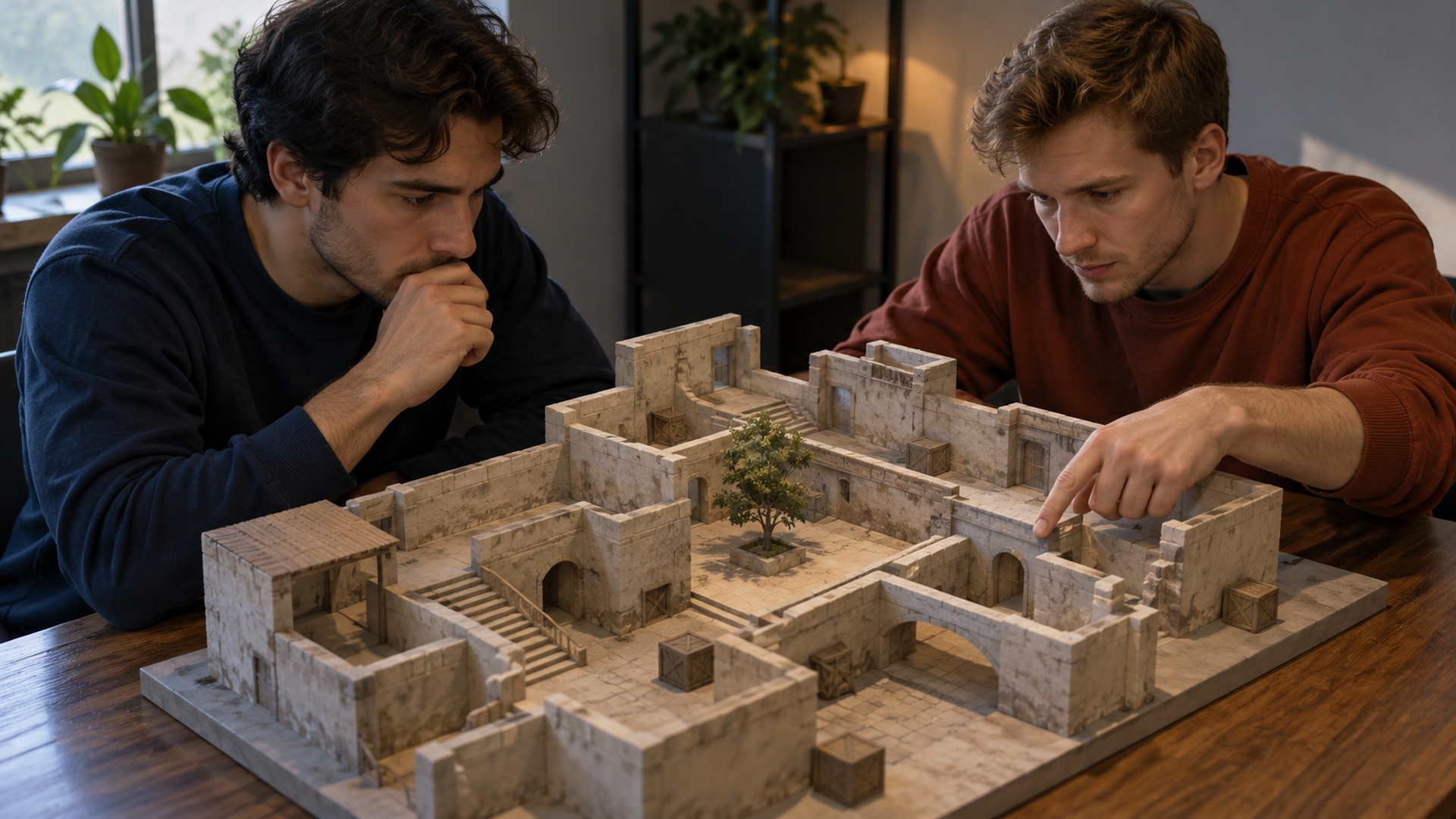
A decision exercise needs more than repeatedly selecting an answer you already know. Present a situation with at least two plausible actions and identify what information would favor each. You can use a replay paused before a commitment, a map walkthrough, or a controlled scenario supported by your game. The point is to connect an observation with an action you can explain.
For example, imagine deciding whether to continue through a contested route or wait for support. State the teammate position or observed threat that would change your choice. Then compare that explanation with what the scenario actually shows. This is a deliberately constructed example, not a claim that waiting is always correct.
Keep the exercise tied to the main skill. If today’s task concerns preparing an entry, the decision should influence when or how that entry happens. A collection of unrelated tactical puzzles may be interesting, but it can make the routine less coherent. You want the blocks to meet again when the practiced situation appears in play.
A 40-minute team session turns a shared idea into a test
A small group can use five minutes to agree on one situation, ten to walk through the intended roles, fifteen to test variations, five to inspect a recording or observations, and five to decide the next adjustment. That adds up to 40 minutes. Keep it in a custom or controlled environment where the group can manage the exercise responsibly. A full competitive match needs its own realistic time allowance rather than being squeezed into a drill’s remaining minutes.
Make each teammate’s contribution visible
During the walkthrough, give every participant a responsibility that another person can understand. One player might observe an approach, another communicate a change, and another wait for a specific cue before moving. The exact roles depend on the game. What matters is that the team can describe how the actions depend on one another.
In the variation block, change one condition at a time. Adjust the approach, remove an expected piece of information, or have the group respond to a delayed cue. Ask whether the original plan still makes sense. A useful team exercise teaches when to modify an intention as well as how to execute it cleanly.
Keep live matches outside artificial time limits
If ranked play is part of the evening, reserve enough uninterrupted time for the actual mode, including the possibility that it lasts longer than expected. Treat the timed routine as preparation or a separate learning block. Once a match begins, its responsibilities take precedence over a stopwatch. Select one practice intention that can arise naturally, then let the match’s objectives determine your actions. Afterward, add a brief review rather than immediately forcing another queue to fit an imagined schedule.
Progress an exercise by changing one demand
Increase difficulty when the current task is understandable enough that you can explain most unsuccessful attempts. You might add movement, require a choice between alternatives, or reduce preparation time modestly. Choose a change that resembles a demand from your matches. A harder exercise is only useful when it helps the intended skill meet a relevant challenge.
If the new version becomes confusing, return to a simpler form and identify which demand caused the trouble. This is a practical adjustment, not a failure to commit. You can alternate a clear controlled attempt with a more contextual one to compare them. The result should tell you whether the skill itself is unreliable or whether the new situation makes it difficult to recognize the right moment.
Avoid increasing several variables solely because a score improved once. An isolated good attempt may reflect a favorable sequence. Look for repeatable behavior and a clear connection to play. Your routine should produce evidence that is useful for the next choice, rather than an endless escalation of difficulty for its own sake.
Review the transition between blocks
The most informative comparison is often what changed when you moved from control to context. Perhaps an input was reliable alone but disappeared when you also had to watch a teammate. Perhaps the decision was sensible in a pause but difficult to recognize at normal pace. Locate that transition. It tells you which supporting demand the next practice should introduce more carefully.
Record the result in a short factual sentence. Say that you recognized the cue late or lost accuracy after moving, rather than summarizing the whole session as good or bad. A clear observation remains useful when you return several days later. It also makes advice easier to request because another player can understand the actual situation you want help with.
Adapt the timetable without removing the learning purpose
These durations are examples, not evidence of one universally optimal amount of practice. Shorten the routine by narrowing the target and keeping a small review, rather than keeping every exercise and rushing through all of them. Extend it when you have a specific reason to collect more attempts or test another relevant variation. A timetable succeeds when its blocks still have understandable jobs. The number of minutes is a constraint that helps you plan, not a score that proves the session’s quality.
Build a week around complementary sessions
Use different visits for different stages of a skill. An early session can establish the controlled action, a later one can add the decision, and another can test it in appropriate play. Keep the target connected across those visits so the observations accumulate. You can then decide whether the next week should deepen the same skill or address a different limiting situation.
Include room for ordinary enjoyable play. A schedule that turns every match into a test may become difficult to sustain, even if its individual exercises are sensible. Be clear about which sessions are focused practice and which are simply time with friends or a favorite game. That distinction lets you bring deliberate attention to training without making all leisure depend on visible progress.
Keep a shorter version ready for interrupted days
Choose in advance which block you would preserve if the evening becomes shorter than expected. A controlled task followed by one reviewed example can maintain the connection between action and evidence when a full routine is impractical. Avoid moving immediately into a live queue simply because the original timetable no longer fits. You can leave a contextual test for the next suitable visit and record the reason for doing so. This makes the routine adaptable without pretending that an unfinished session has already demonstrated whether the skill transfers into ordinary play.
End with a next step small enough to begin
At the end of the session, choose a next action that follows from what you observed. Repeat a controlled movement if its result is still inconsistent, add a relevant cue if recognition is the issue, or discuss a role dependency if the team plan broke down. Avoid writing an ambitious list of every weakness you noticed. The next routine needs a useful starting point, not a complete account of everything you have yet to learn.
A coherent session can improve the quality of your practice even when the scoreboard offers no immediate celebration. You have given the time a purpose, made the main activity observable, and linked it to a situation you care about. Return to that connection when deciding whether the routine deserves another visit. Better competitive habits grow from repeatedly understanding what you are trying to change and what the latest attempt actually showed.