Study the moment you decided what would happen next
You turn toward an expected opponent, but the actual danger comes from somewhere else. Calling the moment bad game sense names the frustration without explaining the decision. A more useful review asks what you knew, what you assumed, and which clue might have changed the prediction. That work can happen outside another full match. A short replay passage, a map inspection, or a carefully reconstructed situation can reveal how you read information and convert it into action. The aim is to build understandable cues for future decisions, while accepting that opponents can still make choices you could not reliably predict.
A: Noticing information, interpreting it, anticipating possibilities, and choosing a useful response.
A: It helps prevent later knowledge from becoming part of the evidence you assume was available.
A: No; consider how much time has passed and what movement was possible.
A: Examine the inference that another area's activity justified abandoning coverage without a handover.
A: Look earlier for the commitment that removed meaningful alternatives.
A: It can reveal the earlier preparation and conditions that made the outcome manageable.
A: A recognizable observation linked to a response and the conditions where it applies.
A: It may rely on hidden information you could never have used during the original decision.
A: Use visible evidence and label explanations requiring unseen information as possibilities.
A: One clear prediction or cue that you can recognize, test, and examine afterward.
Define game sense through the choices you can explain
Game sense is a convenient name for several connected activities: noticing relevant information, interpreting what it suggests, anticipating possibilities, and choosing a useful response. Treating it as one mysterious instinct makes improvement harder to investigate. A player can notice the right cue and misread it, or understand the situation and still choose an action that leaves little room for error. Those problems need different explanations.
Begin with a specific decision rather than a broad rating of your awareness. Ask why you moved, waited, committed a resource, or expected someone to appear. An explanation can be reasonable even when the result is unfavorable. The useful question is whether the choice made sense from the information available then, and whether another action would have handled the uncertainty more effectively.
Freeze the replay before the outcome becomes obvious
Choose a moment immediately before an important commitment. Stop before the elimination, objective loss, or successful play reveals what happened. Write down the plausible next events using the player’s viewpoint. This prevents your knowledge of the ending from silently becoming part of the evidence you assume was available during the match.
Use the current replay or recording tools supported by your game and platform. If the view reveals opponents that the player could not see, keep that extra information separate. An observer perspective can explain why an encounter unfolded while still being the wrong basis for judging the original choice. You want to understand the decision under its actual limits.
Then play the sequence forward and compare the result with your possibilities. A surprising outcome can reveal a missed cue, an unsupported assumption, or simply a low-probability event. Do not force every surprise into the first explanation that makes it feel avoidable. The review is useful when it distinguishes those possibilities honestly.
Make an information inventory before proposing a better play
List what was directly observed, what a teammate reported, what remained uncertain, and what you inferred. Keep the categories separate. A recent location report is evidence, but it does not guarantee that the opponent stayed there. An absent threat is different from a threat you have not checked. The purpose is to make the uncertainty visible before you construct a confident alternative. Once you can see which parts of the explanation are supported, you can decide what action would gather information, protect an objective, or preserve flexibility.
Trace a fictional rotation error from the first assumption
Imagine a team-based objective shooter in which you leave a guarded route because you expect pressure elsewhere. This is an illustrative scenario, not a report of a particular match. You heard an encounter in another area, received no confirmed report of additional opponents, and assumed your current route no longer mattered. You moved before a teammate could take over the responsibility.
The later loss might tempt you to say that you should simply have stayed. Start earlier. The first unsupported step was treating activity elsewhere as proof that the guarded route was safe to abandon. The useful lesson concerns the strength of that inference and the missing handover. A different outcome on one attempt would not automatically make the same reasoning reliable.
Compare alternatives by the responsibilities they preserve
In the fictional situation, consider several responses: remain in place, request confirmation, move to a position that covers a transition, or arrange a teammate’s handover before leaving. Each has a purpose and a cost. Waiting may delay useful support, while moving can expose a route. There is no need to invent one universally correct action without knowing the game’s exact circumstances. Compare which responsibility each option preserves and what additional information would justify changing it.
Find the earliest decision that restricted later options
A replay’s dramatic moment is often downstream of a quieter commitment. You may focus on a difficult final encounter while overlooking the route that left no retreat, the resource already spent, or the teammate position you stopped monitoring. Rewind until you find the point at which a meaningful alternative was still available. That is a better place to examine the decision.
Distinguish a choice that created the problem from an action that merely failed to rescue it. A difficult recovery can be mechanically impressive without being the best long-term practice target. If the original approach repeatedly produces the same unfavorable condition, study that approach first. You may discover a simpler change than trying to win a desperate situation more often.
Apply the same method to a successful play. Ask which earlier action made it manageable and whether that action can be recognized in another match. Success contains information about preparation and timing, not just proof that the final execution worked. Reviewing both outcomes prevents the learning process from becoming a search only for blame.
Turn a lesson into a cue with an attached response
A vague lesson such as watch the map asks for attention without specifying what the attention should accomplish. A usable cue links an observation to a decision. You might decide to confirm coverage when leaving a responsibility, or check a relevant route after a new report changes where pressure seems likely. State the observation, the action it suggests, and the condition that would make the action unnecessary.
Keep the cue short enough to recognize during ordinary play. A long explanation belongs in review; a live decision needs a compact reminder. Test whether you can notice the trigger without ignoring everything else. If the cue requires constant conscious narration, simplify it or choose a clearer situation until it becomes easier to apply.
Inspect the map as a set of relationships
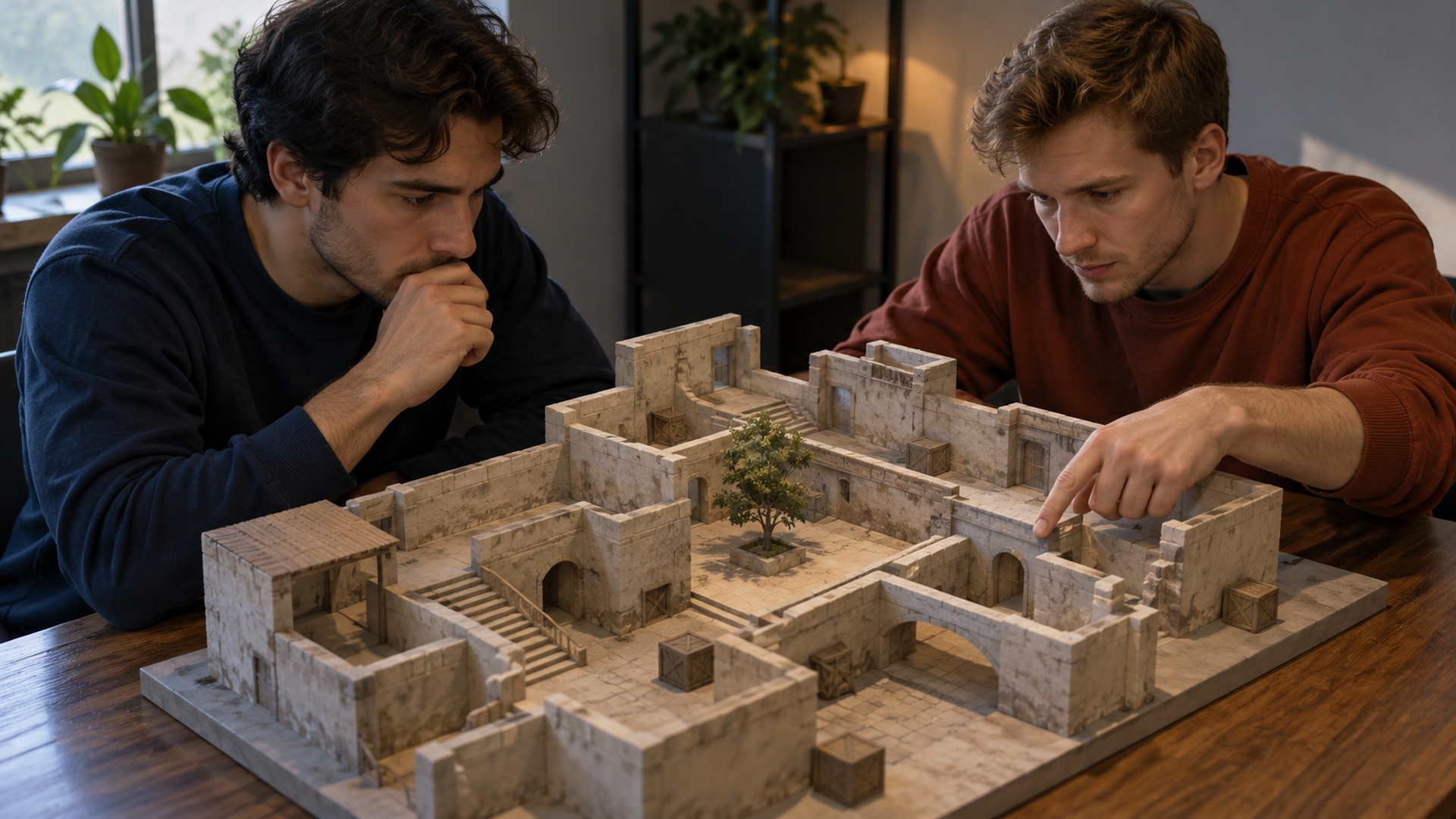
Use a quiet walkthrough to understand which positions connect, what becomes visible from a location, and where another player would need time to travel. Work within the actual game rather than importing assumptions from a different title. The useful result is a better picture of what a movement changes. A location matters because of the routes and responsibilities around it, not because memorizing its name automatically supplies strategy. Connect the place to a decision you encountered in review.
Test a counterfactual without inventing information
A counterfactual asks what might have happened if you had chosen another action. Keep it modest. Replace one decision and consider the plausible consequences, including how opponents could respond. Avoid constructing a perfect alternative that assumes you suddenly knew every hidden position. Such an explanation can look impressive while offering nothing you could recognize in a future match.
Ask what would make the proposed alternative fail. Perhaps waiting creates an urgent problem elsewhere, or the position you prefer cannot cover the route you imagined. Checking those limits makes the lesson more useful. You are looking for a decision that handles uncertainty reasonably, rather than a story in which hindsight removes all risk.
Borrow a stronger player’s information process
When watching a skilled player, look beyond where they aim or which route they take. Identify the observation that seems to change their intention. Notice what they decline to do and which responsibility remains protected as a result. A professional sequence often depends on teammates and preparation you cannot simply reproduce in an ordinary queue.
Reduce the observation to a principle you can test in your own circumstances. You might learn to seek confirmation before abandoning coverage rather than copying a particular rotation. That preserves the relationship between information and action while allowing the details to vary. It also gives you something concrete to discuss if another player’s interpretation differs from yours.
Keep uncertainty in your analysis of the expert too. A broadcast may not reveal every communication or part of a team’s plan. Describe what the visible evidence supports and label the rest as a possibility. Honest limits make the example more informative than a confident explanation built around facts the recording never provides.
Use several examples before declaring a permanent rule
One replay can reveal an interesting possibility without proving that it should govern every similar moment. Collect a few comparable situations and look for which conditions repeat. You may find that a cue works only with nearby support, a particular resource, or enough time to act. The condition is part of the lesson. Recognizing it prevents a useful observation from hardening into a habit that becomes predictable or inappropriate in another context.
Return to matches with a prediction you can review
Before your next suitable game, choose one cue and state what you expect noticing it to change. During play, allow the situation to determine whether the cue applies. Afterward, examine an opportunity where it appeared and compare your action with the original intention. A match then becomes a test of an idea rather than simply more time spent hoping awareness will improve.
Record missed recognition separately from an incorrect interpretation. You may need a clearer trigger in the first case and a revised explanation in the second. If the response was sensible but execution failed, the next task may concern mechanics instead. Distinguishing those outcomes keeps game-sense work connected to the particular part of the decision that needs attention.
Check the prediction that never reached the screen
Some assumptions influence a decision without ever becoming a spoken call or a conscious sentence. You may have expected support to arrive, believed a route was already covered, or treated a previous encounter as evidence that pressure would continue in the same place. Reconstruct those assumptions carefully from the sequence and label uncertain recollections as uncertain. Then ask which assumption a brief communication or additional observation could have checked before commitment. This can reveal an actionable lesson even when the final movement looked reasonable in isolation, because the weakness lay in an expectation the other players never shared.
Keep the review small enough to finish
Choose a short passage with a meaningful decision and stop when you have a usable explanation. An exhaustive review of every mistake can leave you with too many competing instructions for the next match. A single well-defined cue is easier to test honestly. Save interesting additional moments for later instead of treating them as an urgent assignment to fix everything.
Game sense becomes less mysterious when you can describe the path from information to expectation to action. Replays, walkthroughs, and conversations can help you investigate that path without adding another full match to every evening. Continue playing because you enjoy the competition, and use review to make one part of it more understandable. Better predictions begin with a clearer account of what you knew and what your chosen action was trying to protect.