Borrow a professional’s purpose before borrowing a professional’s timetable
Training like an esports pro does not require treating a beginner’s evening as a full-time job. The useful idea is to know what you are trying to improve, choose practice that addresses it, and check whether the change appears when you play. Without that connection, a long session can contain plenty of effort and little useful evidence. A beginner benefits from a smaller process: identify one recurring difficulty, make it specific enough to practice, apply it in a suitable match, and review what happened. The goal is a plan you can explain and repeat, with room to change it when your own play shows that a different problem deserves attention.
A: No; borrow a purposeful learning process and scale it to the time you can sustain.
A: It identifies a behavior you can recognize and review in a particular situation.
A: Examine whether the decision created a sensible opportunity before judging its mechanical execution.
A: First identify which weakness it addresses and whether that matches your own evidence.
A: Record that honestly and seek another suitable opportunity instead of forcing it.
A: Start with a few moments directly related to the behavior you are investigating.
A: Count relevant opportunities and deliberate attempts before relying on match results alone.
A: Ask for specific observations about the behavior rather than a broad verdict on your skill.
A: No; focused practice and playing for enjoyment can both belong in a sustainable week.
A: When review shows that a different earlier decision or a clearer weakness deserves attention.
Begin with a problem you can recognize during play
Getting better is an intention, not yet a practice goal. Choose a recurring situation you can describe without using your rank as the explanation. You might struggle to keep an opponent in view, arrive late to a team objective, or enter an area without understanding what your teammates cover. These situations point toward different skills. Treating all of them as an aim problem can send practice in the wrong direction.
Use an ordinary recent match as your starting evidence. Find a moment that represents something you have noticed more than once, then describe the action and its consequence in plain language. Avoid building a complete theory of your ability from one memorable mistake. A useful first target is narrow enough to recognize again and important enough that changing it would improve the way you participate.
Separate execution from the decision that asked for it
Imagine losing a difficult duel after exposing yourself to more than one angle. The final missed shot is visible, but it may not be the most useful first problem to solve. You might need a more controlled approach, a better understanding of the route, or support that you entered before receiving. Mechanical practice can help you execute a sensible action; it cannot make every chosen fight sensible.
Ask whether you understood what you intended to do and whether the action was appropriate with the information available. If the intention was clear but execution failed, a targeted drill may fit. If you cannot explain why you chose the action, examine the decision first. You do not have to diagnose every weakness perfectly. The distinction simply gives your practice a more thoughtful starting point.
Keep the explanation provisional. A later review may show that your initial diagnosis missed something, and that is a normal reason to revise a plan. Improvement does not depend on proving your first theory correct. It depends on noticing when the evidence points toward a more useful explanation.
Write a goal that describes a behavior rather than an outcome
A useful goal states what you will try to do when a recognizable situation occurs. For example, you might check a teammate’s position before committing to a contested route. That goal can be observed even if the match is lost. Winning more is a desirable outcome, but several teammates and opponents influence it, so it is a noisy way to judge one beginner’s experiment. Keep the behavior small enough to remember while playing and clear enough that a review can distinguish an attempted improvement from an occasion when the situation never arose.
Choose a practice task that actually resembles the weakness
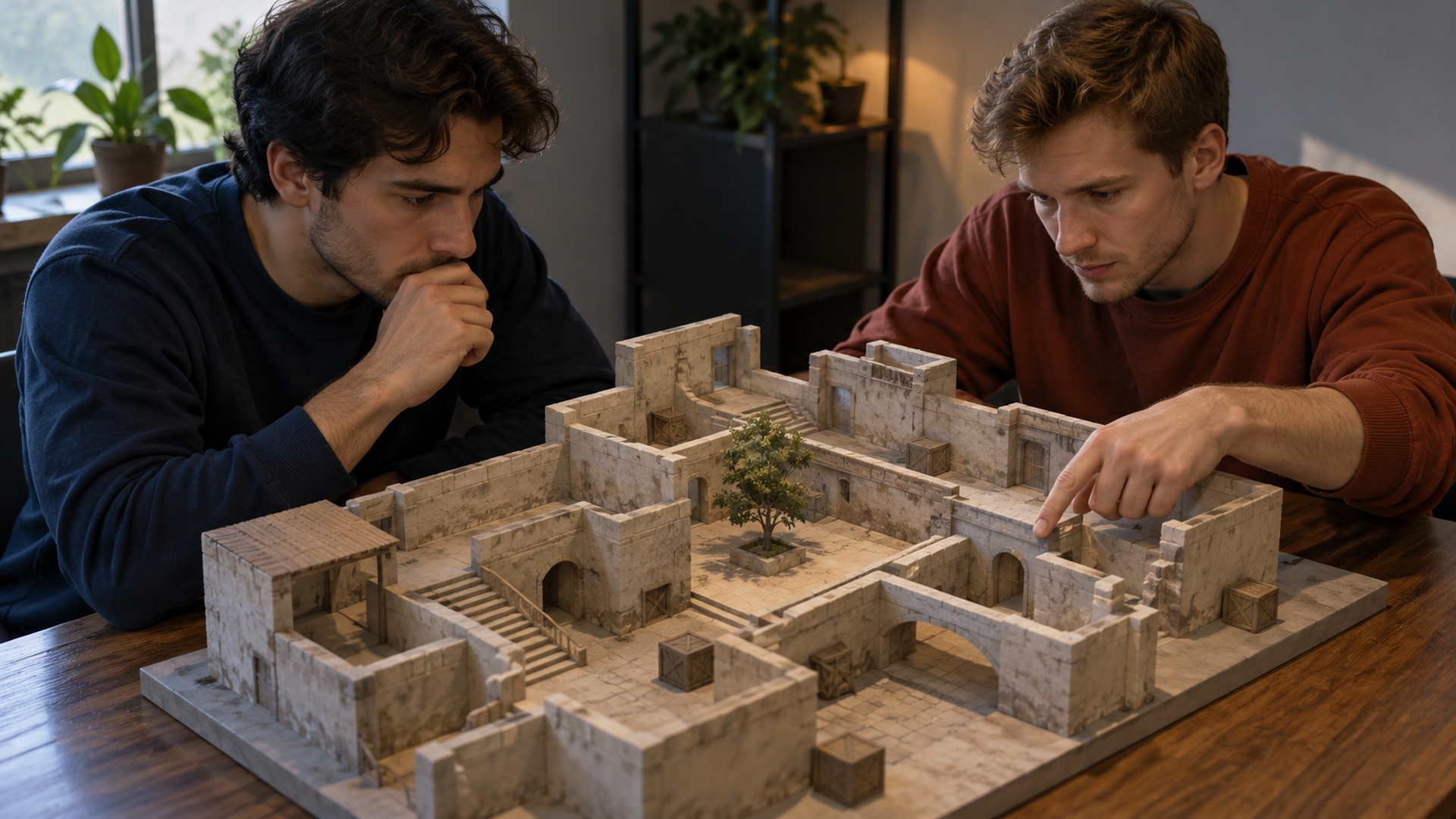
A drill earns its place by helping you investigate the chosen behavior. If the difficulty is a particular input, find a practice environment where you can repeat that input with clear feedback. If the difficulty is recognizing an approach, examine a map or a small set of comparable replay moments. Do not select a drill only because a successful player uses it for a different purpose.
Describe what you expect the task to teach before beginning. A controlled exercise can let you notice an execution detail that is difficult to isolate in a match. It can also become disconnected from play if you pursue its score without understanding its role. The relevant result is whether the practiced action becomes more reliable in the situation that made you choose it.
Keep the practical setup stable enough to learn from
Frequent changes to sensitivity, bindings, or equipment can make it difficult to interpret a practice result. Establish a comfortable, functional setup and give yourself time to understand it. Change something when a specific problem justifies the adjustment rather than after every frustrating loss. Use official support and current platform information when troubleshooting compatibility or game-specific settings. Consistency is useful because it lets you compare your own attempts, not because one universal configuration will suit every player.
Carry one intention into a real match
A controlled exercise and a match ask for different kinds of attention. Once you understand the practice task, choose an appropriate mode in which to look for the same behavior. Your objective is to notice the relevant situation without trying to manage several new goals at once. A beginner can easily lose the thread by adding positioning, communication, mechanics, and complex strategy to the same mental checklist.
Accept that the behavior may be awkward at first. You might remember to check a position but take too long to act on it, or perform an input correctly while overlooking another demand. Those observations help define the next step. The aim of match application is to discover what happens when the skill has to coexist with ordinary play.
Do not force the practiced action into every encounter. A useful skill belongs to a context, and recognizing when it does not apply is part of learning it. If the chosen situation never appears, record that instead of manufacturing an opportunity that harms the team’s objective. You can select another suitable match or refine the target afterward.
Review a small amount of evidence while the goal is still clear
After playing, inspect a few relevant moments rather than reviewing the entire match without a purpose. Ask whether the target situation occurred, whether you recognized it, and what your action changed. Include a successful attempt if one is available. Success can show what conditions made the behavior easier to perform, while a mistake can reveal what interrupted it.
Use the game’s current replay tools or a recording option suited to your platform, checking the official instructions if needed. You do not require a complicated production setup to begin learning from evidence. A short written recollection can be a temporary starting point when a recording is unavailable, provided you recognize its limits. Avoid treating a confident memory as a complete account of what every player knew.
Choose a measure that matches the experiment
For a behavioral target, count relevant opportunities and deliberate attempts before searching for a sophisticated metric. If the goal was checking support before entry, the useful comparison begins with whether you did it when it mattered. A match score can provide context without becoming the only verdict. Keep the measure simple enough that collecting it does not crowd out playing. The record should help you decide what to practice next, rather than become another performance you feel obliged to optimize.
Ask for feedback another person can actually provide
A teammate can offer more useful feedback when you state the behavior you are working on. Ask them to describe a specific moment instead of judging your overall ability. They may have noticed information you missed or experienced a consequence from your action. Keep the conversation focused on what happened and what a different choice might have made possible.
When feedback disagrees with your interpretation, return to the evidence if it is available. You can compare viewpoints without turning the discussion into a contest over who understands the game better. One person may be describing the intention while the other is describing the effect. Both can help refine a goal when you keep the distinction clear.
Do not request a full critique during a tense live encounter. A concise actionable call belongs there; a detailed explanation usually needs a pause. Agree on how you want help before frustration develops. A supportive learning arrangement makes it easier to ask about uncertainty without interrupting the group’s immediate task.
Fit the process to your week before increasing its size
A manageable plan should survive an ordinary busy week. Choose a scale that leaves room for practice, actual play, and a brief review without requiring you to imitate a professional’s full-time schedule. When time is limited, reduce the number of goals rather than squeezing several unfinished tasks into the same session. A small completed learning cycle offers clearer evidence than an ambitious plan that never reaches its review. Consistency here means returning to a purpose, not meeting an arbitrary number of hours.
Keep rank in perspective while the skill is changing
Ranked results matter to competitive players, but a single result contains more than the effect of one training choice. Opponents, teammates, the particular situation, and your ability to use the new behavior all contribute. Watch for evidence that the behavior is becoming more deliberate across several relevant opportunities. That is a more useful early signal than requiring an immediate sequence of wins.
Also distinguish competitive practice from time spent playing simply because you enjoy the game. Both can belong in your week. Not every casual session needs a diagnostic record or a measurable objective. A clear boundary can make focused practice easier to sustain because it does not turn all play into an obligation to improve.
Make the evidence useful when motivation changes
A short factual record can support the process when the excitement of starting a plan has faded. Keep the situation, intended behavior, and one observed result together so you can reconstruct the purpose without remembering the whole evening. If you miss a planned session, use that record to resume the same manageable experiment instead of compensating with an oversized practice day. It also helps you recognize genuine changes in your interests: perhaps a different role now makes the original target less relevant, or the repeated situation has become easier to explain. Let the record support a thoughtful next choice rather than turn it into an attendance score.
Decide whether to continue, simplify, or replace the target
At a review point, ask what your evidence now supports. Continue if the behavior remains useful and the main difficulty is becoming more familiar. Simplify if the goal was too broad to remember or the practice task did not isolate it. Replace it if you discovered that another decision consistently creates the original problem. These are adjustments within a learning process, not admissions that the entire approach failed.
Write the next target in the same concrete way you used for the first. Include the situation, intended action, and the evidence you will look for afterward. You now have a beginner’s version of disciplined competitive preparation: a purpose, a task, an application, and an honest review. It can grow with your understanding without requiring a dramatic timetable from the first day.
The most useful professional habit is treating performance as something you can investigate. Start small enough that you can see the connection between a choice and its result. Ask for specific help when the connection is unclear, and revise your explanation when your own play contradicts it. That creates a path toward improvement that belongs to your circumstances and remains understandable after the excitement of the first practice session fades.